The cliffs of Moher
There is a wildness in Clare like no other. It is not the
bitter and majestic wildness of County Kerry; it is instead a contained
wildness. Parts of it look relentlessly barren, but this Burren holds many
surprises and many places of beauty both small and vast. Any visitor making
their way up the winding roads towards the cliffs of Moher cannot fail to
notice a holy well dedicated to Brigid, one of Ireland’s most loved and
possibly most visited holy wells. This well has a long history and over time
has developed a complicated set of rounds or turas’. My journey began with a trip to the famous cliffs and I
stumbled on this well by accident. I knew of its presence in the area, but my
OS map, recently reprinted, oddly decided to leave out all holy well markings.
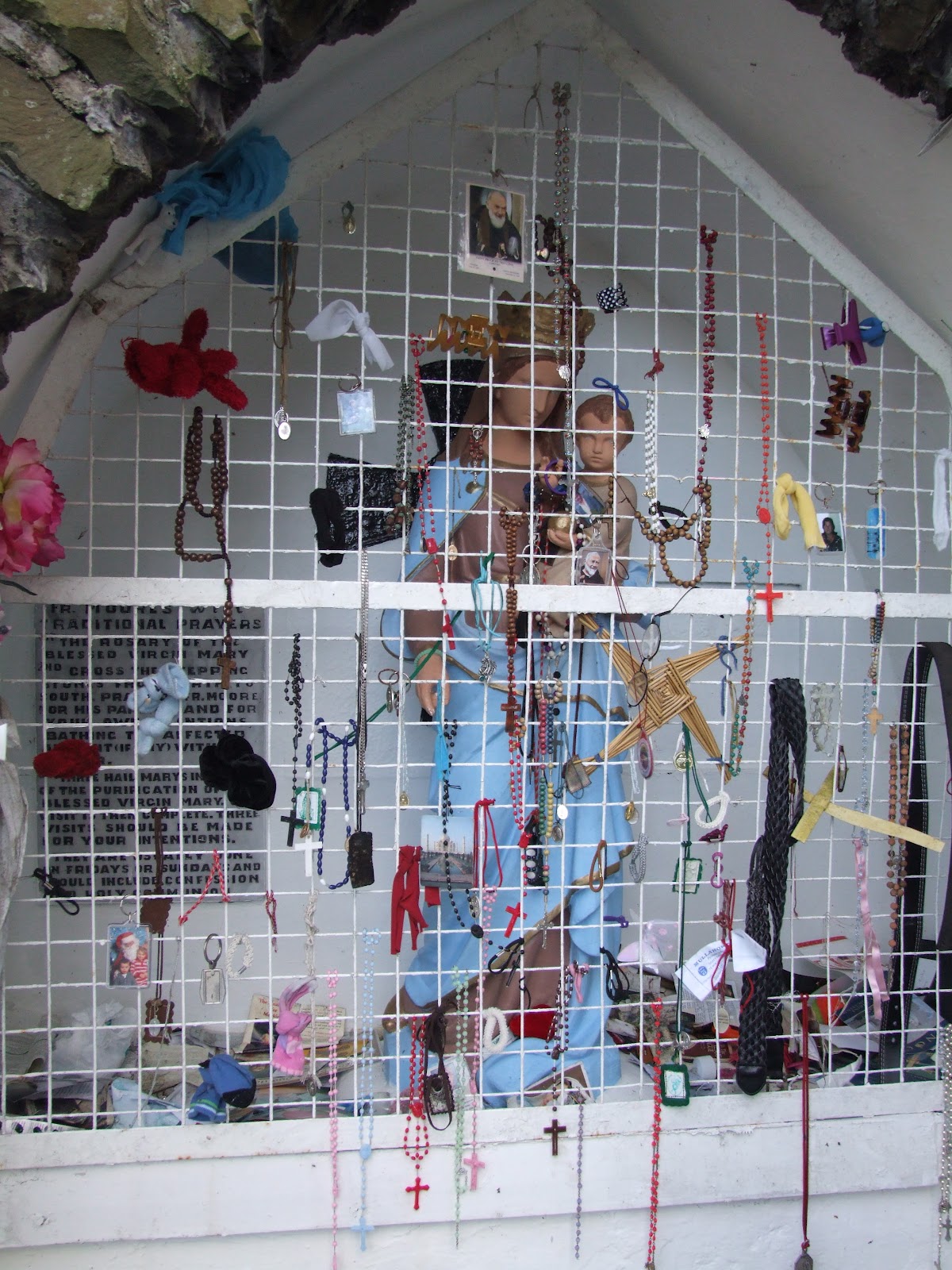
I passed Brigid’s shrine at speed, but couldn’t help but notice her solemn form
encased in glass keeping watch over a vista that looked down on small dotted
cottages and a small town.

Saint Brigid
The cliffs of Moher reach a maximum of 702 feet above the
roaring Atlantic, its name taken from a fort long gone. Twenty different
species of birds occupy this fearsome bastion of rock and its views are
certainly spectacular. Its wildness has been tamed by a somewhat ugly concrete
and stone structure to contain tourists, but it is possible to make the journey
along the cliffs where the structure dissolves into crumbling paths that give
way to more spectacular views. Away from this exposed magnificence, just a
short distance down the road is the little vale of trees that bow in solemn
reverence to Brigid’s well.

The holy well entrance
Brigid’s shrine is divided into two sections; the upper
sanctuary (Ula Uachtarach) and the lower sanctuary (Ula íochtarach). From the
road I pass through a small gap in the low wall into a courtyard area with a
large mound in the centre topped with a statue of Saint Brigid encased in glass
that sits like a great lantern in the centre with Brigid as its only flame.
Various pools are exposed in the circular round, indicating the presence of the
well and a white painted lintel brightly exposes the way. It has a mysterious atmosphere as the
sun begins to fall low in the sky and the great cleft in the rock feels
curiously daunting. As I enter it is dark and uninviting and the smell of
dampness and its embracing coldness has a penitential feel. The walls are
dripping with prayer; the petitions for the sick, with expressions of
thanksgiving, wails of sorrow and grief and moments of hope. Planted at their
centre is a crucifix that looks hewn in hawthorn, worn down by burden and
incarnationally present amidst this mass of prayer and devotion. Passing down this
rock of ages a few small candles flicker towards the light rattle of water into
a trough. Here is the well, said to visited by a fish – an indication that this
well is truly ancient in its Christian tradition – the fish being a symbol of
Christianity that predates the cross. Passing down this cleft in rock is a
little like passing through time to a more ancient faith, to a purity of
prayerful expression. This vale of solace is a far cry from the exposure of the
cliffs.

Offerings at the well
Pattern days are still observed at this well. There are four
in all: the eve of the feast of Saint Brigid, Garland Saturday and Sunday, the
last Sunday of July (and its Vigil – a harvest festival to ask blessings on the
crops and animals) and the feast of the Assumption in August. In the past great
gatherings of many hundreds of people took place here with people from all over
County Clare and the Aran Islands who covered the site in small flickering
candles as they prayed. The Rite of Saint Brigid at the well is still said
today, although in a slightly less demanding format. The pilgrim makes a
salutation to Christ, then Brigid and Mary (this is known as a ‘rann’, or ritual
verse), reciting numerous ‘Hail Mary’s’ and ‘Our Father’s’ and ‘Creed’s’ before
reciting the same at various points along the path through the lower sanctuary
and up into the upper sanctuary before finally entering the well.

The cross in the upper sanctuary
The upper sanctuary is accessed by a small winding path that
makes its way up through the trees to a stone cross that stands at the entrance
to an ancient cemetery, said to be the burial grounds of the Kings of Dái gCais
and containing the mausoleum of Cornelius O’Brien. Cornelius O’Brien was an
interesting local character who was highly regarded in his day. He was a solicitor for Ireland from
1811 and became magistrate for Clare. Despite being a Protestant landlord,
local Roman Catholics held him in high esteem for his political stance in
relation to Ireland and for his care of tenants. He took great care of his
tenants houses, ensuring they were always in habitable condition and well
maintained and clearly had a great love of the area. He ensured there was ease
of access to the cliffs of Moher and paid for pathways to be maintained and the
erection of seating, a viewing tower and a structure known as ‘the Round
Table’. In 1840 Cornelius fell
seriously ill while in England and sent for water from Liscannor holy well
which he promptly drank. Attributing his recovery to the healing waters he
endeavoured to restore Saint Brigid’s holy well, which was in a state of
considerable disrepair at the time, and he paid for its restoration and greatly
encouraged devotion at the site. He returned to Ireland during the famine years
and is said to have done all he could to provide food to the starving and later
he established a national school for the area. However, like many landlords of
the time he was not without a sense of self importance, ensuring that a
prominent O’Brien monument would be permanently present at the well after his
death and that locals would also remember his presence in connection to the
well with his imposing mausoleum overlooking the entire cemetery. A short
distance from the well there is another well by the road. This is not a holy
well, but one that locals used for washing and gathering water for cooking and
cleaning. Cornelius O’Brien created a stone housing for the well, topped by his
crest. History was to be unkind to Cornelius as Ireland’s political landscape
shifted in a way in which he might have approved of, yet set him squarely on
the wrong side of the fence. Despite his own actions and political sentiment,
his denomination and his national allegiance was to unfortunately tarnish his
record in an area where dreadful atrocities were committed and whose people
were unable to distinguish him any longer from the newly deposed ruling elite.

Saint Anthony, to help you find what you lost
It is not difficult to understand why this holy well is so
popular, quite apart from the fact that it is on a very popular tourist route.
It’s sheltered spot gives a sense of relief to the pilgrim and tourist alike
with a feeling of shrouded mystery to its dark cleft leading to the well and
its rambling graveyard. This is a place that undoubtedly rewards return visits,
yet is best frequented early in the morning or a little later in the evening to
avoid the throngs.

The holy well
Rock of ages, cleft for me,
Let me hide myself in thee;
Let the water and the blood,
From thy riven side which flowed,
Be of sin the double cure,
Cleanse me from its guilt and power.
Nothing in my hand I bring,
Simply to thy cross I cling;
Naked, come to thee for dress;
Helpless, look to thee for grace;
Foul, I to the fountain fly;
Wash me, Saviour, or I die.
While I draw this fleeting breath,
When my eyes are closed in death,
When I soar through tracts unknown,
See thee on thy judgement throne;
Rock of ages, cleft for me,
Let me hide myself in thee.
Augustus Toplady (1740-78)

Looking out from the well
How to find it:
The well is impossible to miss! One mile down the hill from
the car park at the cliffs of Moher on the right hand side you will see the
statue of Brigid in her glass case surrounded by a low stone wall.

The Stack at the cliffs of Moher