Showing posts with label healing. Show all posts

Thursday, August 23, 2012

Two Wells at Lough Ine, County Cork.

Our Lady of the Fuchsia!


Lough Ine (or Hyne) is a marine lake in West Cork around five kilometers from the town of Skibereen. Being rather shallow and yet highly oxygenated it sustains an unusually high level of plant and animal life, many of which are not found anywhere else in Ireland. It is a beautiful and a bit of trap for tourists and Sunday afternoon drivers. If the sun is shining be prepared to meet a minor traffic jam!

Lough Ine (Hyne)

Above the lake is a steep hill (Knockomagh Hill) with paths winding around the bottom and all the way to the top. If you attempt the climb to the top of the hill, even though it isn’t a particularly large hill, the climb is nonetheless somewhat strenuous, but worth the views when you reach the top.  From this vantage point you can get a glimpse of both the ruins of the castle on Castle Island (once associated with the O’Driscoll clan) in the centre of the lake and the ruins of Saint Brigid’s church on the opposite shore.

Tobarín Súl

The two holy wells in the area are known as Skour Well and Tobarín Súl. Saint Brigid’s well is also beside the church ruins of the same dedication and Saint Brigid is said to have spent some time in the area. Legend has it that when she knelt to pray at a rock near the holy well, she left the impressions of her knees! Following the path around the base of the hill you will cross a small trickle of a stream and land on a path that begins a slow climb uphill. On the right the first well that you will see is the Eye well, or Tobarín Súl. This well is renowned throughout the area as being a very powerful well to heal any complaints regarding eyesight or the eyes. Many offerings of various kinds have been left by the well which is surrounded by a mound of stones and various trinkets and offerings. A three trunked tree grows up out of the back of the well and stands like a sentry. I couldn’t help but recall the moment in the Gospel when Jesus begins to heal a blind man who says he can see people like walking trees, and after Jesus lays hands on him a second time he can see perfectly. Of this holy well’s past history I was unable to find anything out.

Tokens left at the holy well

The next well is known as Skour well and is located just a short stretch up the hill. It appears that this well’s dedication has either been forgotten or it has never had a dedication. The word Skour probably comes from the Irish ‘sceabhar’ meaning ‘slope’ or ‘slant’, indicating its position on the side of the hill. In the past, on May eve, pilgrims would come and make traditional rounds at the well and drop a white stone. Today the well is surrounded by these white stones, but the May eve pattern is a mass said by the local priest and the well appears today to be thoroughly dedicated to the Blessed Virgin Mary. Crude ‘icons’ of Our Lady litter the site and the traditional hawthorn bush above the well holds the rags of passing pilgrims. A large stone structure surrounds the well, much of which looks thoroughly modern.

Skour Well

In many ways this well is in grave danger of being over-worked. Many wells throughout Ireland have disappeared precisely because people have messed with the natural flow of watercourses and built large, heavy structures around the wells. In some cases they have planted numerous trees and the well has simply dried up. In this case, the well has almost been swallowed up by the stone surround and the stones placed so carefully and neatly around the base of the well. Despite this, there is something rather appealing about this well which I think, for me, lies in the many white stones brought by groups of pilgrims in the past and the naive 'icons'.

The well surround

Lord, high and holy, meek and lowly, Thou hast brought me to the valley of vision, where I live in the depths but see Thee in the heights; hemmed in by mountains of in I behold Thy glory. Let me learn by paradox that the way down is the way up, that to be low is to be high, that the broken heart is the healed heart, that the contrite spirit is the rejoicing spirit, that the repenting soul is the victorious soul, that to have nothing is to possess all, that to bear the cross is to wear the crown, that to give is to receive, that the valley is the place of vision. Lord, in the daytime stars can be seen from deepest wells, and the deeper the wells the brighter Thy stars shine; let me find Thy light in my darkness, Thy life in my death, Thy joy in my sorrow, Thy grace in my sin, Thy riches in my poverty, Thy glory in my valley, Thy water in my well.
Amen.
Charles Spurgeon

A Child of Prague at the Eye well

How to find it:
From Lough Ine, take the path into the woods at the foot of Knockomagh Hill. Follow the path around the foot of the hill, crossing a small stream. The path then veers up to the left and up a slight slope. On the left are the two wells; firstly Tobarín Súl and then a little farther up is Skour well.

A Madonna and Child at the Skour Well


Wednesday, June 13, 2012

Fr Moore’s Well, County Kildare

The signpost from the road


This is a slightly curious well in that it may represent a well that was once dedicated to Saint Brigid, but over time local tradition has planted the memory of a Fr Moore over the top. A few locals nearby will insist that the Saint Brigid’s holy well is a couple of fields over from Fr Moore’s well, but OS maps don’t suggest that and despite a good old rummage around the fields I couldn’t find it. Now I could of course have simply been looking in entirely the wrong place, but I’m not the only person to have thought that Fr Moore’s well was once a well of Saint Brigid and that the well of Saint Brigid ‘of a few fields over’ is in fact a bit of a myth in order to preserve the memory of Fr Moore at this site. For this reason it is a well that leaves me with somewhat mixed feelings. I’m not in any way against the remembrance and dedication of sites to the memory of holy people - this is how the honour of saintliness arrives in some sense – but there is also a good old dose of folk faith, which at times can be fascinating and even enlightening, but at worst can do horrible cultural and historical damage to an area.  What it might have wrecked or built up here I’m not quite sure, but I can only muster a strange ambivalence to this place. However, I cannot help but think that this well is merely an act of archaeological butchery and the ruination of the link to Brigid.

The holy well complete with pebble-dash

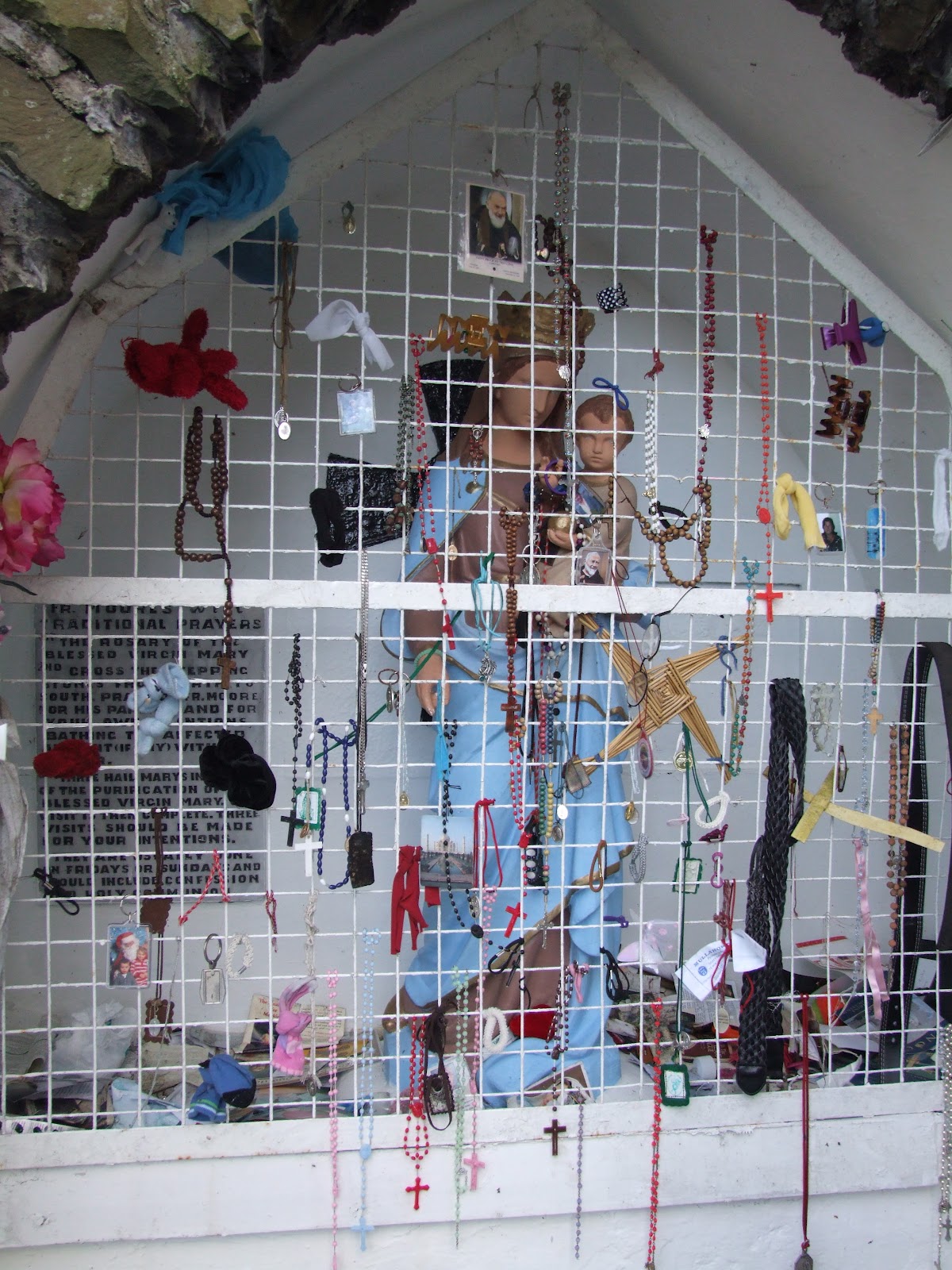
As a holy well it is not entirely beautiful. It has a rather horrible concrete surround and beneath it in the ditch there appears to be a well of sorts too - or at least and overflow. It has a Madonna and child trapped in a cage, a large sign warning you not to drink the water, vague notes about Fr Moore and who he was and the finer points of a ritual observance in order to extract a healing. But despite my own ambivalence towards this site, it is obviously hugely important to the people of the area and it has all the signs of active devotion and the expressions and tokens of hopefulness in prayer.


The Madonna and Child

Fr John Moore was a priest who lived with his mother in a little cottage not far from the well. He was born in Rathbride in 1779 and by 1799 he had enrolled in Maynooth to train for ordination. He was ordained in 1804 and appointed as curate to the parish of Allen and shortly after this he disappears from parish ministry altogether. During his lifetime many considered Fr Moore as having a gift of healing and many visited him for cures. Before his death in 1826 he is said to have blessed the well so that even after his death people might find a cure. Shortly afterwards a parish priest (Fr P. MacSuibhne) published a set of prayers to be said at the well at three visits in order to obtain a cure. The protocol set down by him was to visit the well three times, either on a Friday or a Sunday with a decade of the rosary, followed by a set prayer for Fr Moore and his parents, personal intentions, then a bathing in the well and finally three Hail Mary’s. Over the course of the three visits the person seeking healing should avail of confession and have received communion at least once. The more modern interpretation of this involves the necessity of using the stepping stones across the well.

A warning sign!

Lord Walter Fitzgerald recorded his visit to the well in the Archaeological Society Journal in January 1918. In it he describes the well at the end of a muddy path with crutches and sticks stuck into the soft earth around it as testimony to its curative properties, and the many wooden hand crosses left as a symbol of thanks for healing and answered prayer. He also describes being told a tale of how local clergy and some gentry became concerned by Fr Moore’s activity and renown for being a healer which finally resulted in the Bishop of the diocese paying him a visit and requesting him to stop his practice, but after a supernatural demonstration, the Bishop was convinced of his ability. But he is also told of rumours that Fr Moore was a silenced priest, which would explain why in later years he had no connection to a parish, while others argued that he refused position in a parish in favour of providing healing for the sick.

Tokens left at the well

To this day the Forde family retain the silk chimney hat of Fr Moore, which I must say looks in rather bad shape. Those who suffer from severe headaches go to the well when the hat makes its appearance and it is set upon their head to enact a cure. I can’t say that I’d be in any great rush to have the old battered hat of what may be a disgraced priest set upon my head for any reason. It’s something of a shame we don’t know the real story of Fr Moore, for speculation of his particular sins that resulted in his possible disgrace will forever hang over this well as a dirty rumour or as a pointer to the truth.

The stepping stones

Where to find it:
On the main road out of Kildare towards Milltown (R415), the well is set back from the road and clearly signposted.