
Gougane Barra
Right on the border with Kerry the River Lee makes its picturesque appearance surrounded by the shelter of high hills and steep slopes to emerge as the great river that takes many turns and floods into loughs and lakes and pools before it finally flows through the centre of Cork city and out to sea. The life of Finbarr has the same meandering quality with its twists and turns through historical reference, ecclesiastical politics and even recent folklore. Untangling all the threads is not an easy prospect and some have more recently suggested that almost nothing can be said of this saint, so enriched by the numerous layers and patina of successive myths. Some have even suggested that Finbarr is completely mythical in character with no historical basis other than a re-appropriation of the cult of Saint Finnian of Moville [Movilla] (on the outskirts of Newtownards) for the purposes of a new locale. If this is the case, then he is one and the same with Saint Finnian who began life on the west coast of Britain, who moved to Moville to become a renowned scholar, who had an association with Britain's earliest historian (Gildas) and who (according to Adomnán) instructed Saint Columba as a young man. So is Finbarr really Saint Finnian; one and the same person?

The enclosure with central cross and cells at Gougane Barra
It is almost impossible to answer that question as so little of the ancient sources of the Life of Saint Finbarr survive. The issue is further complicated by ecclesiastical politics in a time of considerable church reform, involving the Bishop of Cork who was trying to regain his control of the Diocese of Ossory around 1200AD and whose predecessor had birthed the problem after the surprising loss of the diocese at the Kells-Mellifont synod of 1152. The Life document has an unusual obsession with Ossory sites and churches, linking them to the Diocese of Cork and fronting the saint as a uniting factor. It is possible to read the document in terms of a political tract and an attempt at re-uniting a diocese through a cult surrounding a local saint. The original written Life is lost and may only have been available in a written form as late as 1100. What we do have are a number of Life documents in which the hand of an editor or redactor can be seen and which have occupied scholars for many years. Rather than plough further into this issue and incur the wrath of the Rebel County, we shall instead take a look at Finbarr's holy well in the context of his Life document and in terms of the site and geography in which it resides and as we shall see, there may be some challenges to the idea that Finbarr is Saint Finnian in a new wrapping!

Interior of the nineteenth century church
Finbarr is said to have been born around 550AD near the town of Bandon in County Cork and to have studied in Ossory. On taking the tonsure, the monk cutting his hair is said to have remarked that his hair was very fair and Finbarr was the name given to him and may be a play on words for 'fair headed'. He then takes a journey to Rome with a number of other monks, stopping on his return to receive further instruction from Saint David in Wales. On returning to Ireland he lived a solitary life on a small island in Gougane Barra, before moving from here to live a settled life for a period in the Great Marsh of Munster (now Cork city). Here he gathered a band of monks to form a community and built a church which is now Saint Fin Barre's Cathedral. From here he appears to have travelled through County Cork to collect various saintly relics, almost as a tribute to the establishment of the churches in the Great Marsh of Munster (now a collection of small churches and not only one). It is in the process of one of these journeys that he falls ill, receives the Eucharist from the hand of Fiama and dies the same day. His remains were returned to Cork and he was buried in the churchyard. His grave today is incorporated into the ambulatory of Saint Fin Barre's Cathedral, topped with a large inscribed flagstone directly behind the high altar.

Saint Fin Barre's Cathedral, Cork city (image courtesy of the cathedral website)
The Life document of Finbarr is as remarkable as any other document of its type and time. It is full of stories of miraculous beginnings, of words spoken from the womb, miraculous healings of the deaf, the dumb and the blind and even stories of resurrection by the sprinkling of holy water from a well. The saint is also said to have had the touch of God and as a result his permanently glowing hand had to be forever kept in a glove. On the day of his death the monks prayed to have a little while longer with him and through their intercession the sun did not set for twelve days before his death! Today he is the patron saint of the city of Cork with a grand cathedral in a French Gothic style with its famous trumpeting angel of judgement on the roof of the sanctuary. You can see a fine carving of Finbarr as a Bishop high in the nook of Ireland's tallest cathedra in the cathedral chancel, with a relief of his face carved in the side. A considerable number of saints arose from his foundations and the establishment of the city of Cork owes much to his memory and influence. But it isn't only in Ireland that Finbarr makes a mysterious appearance and this may form part of a rejection of the idea that he is merely a local reincarnation of Finnian. Saint Finbarr appears in a number of places throughout Scotland and local tradition about the saintly dedications claim to have their root in Ireland. The most notable of these is on the island of Barra which sports an ancient church ruin dedicated in his name. We also know that some Scottish breviary had a liturgical form of the Life document incorporated into them, the only surviving one being the Breviary of Aberdeen (1509AD).

Cross inscribed slabs in the cells, inscribed by modern pilgrims.
Personally I would lean more heavily to the idea of Saint Finbarr as a historical figure in reality and not a re-appropriated saint for a local people. While there isn't much sure evidence of this, I find the argument that the Life document has a commonality with the history of Saint Finnian to be somewhat unconvincing and I would place more trust in the oral tradition than most would probably dare. Finbarr's Life has undoubtedly been appropriated for various means throughout time, but for me the sheer strength of his cult and its geographical spread hint at a real historical figure.

Inscription on the plaque of the central cross in the enclosure.
Gougane Barra, where Finbarr spent time in isolation, is a very beautiful and peaceful place. The island is quite small, but the site is well protected from the elements and is frequently visited. It has a tiny nineteenth century church that today is very popular as a venue for weddings. A square enclosure houses a number of cell structures and a large cross in the middle proclaims that one is the original cell of Saint Finbarr. In reality the whole structure is an early eighteenth century reconstruction by a priest called Fr Denis O'Mahony who retreated to the island and spent a considerable amount of time there. It is quite possible however, that some manner of cell structure existed here whether connected directly to Saint Finbarr or not and it has been reincorporated into the present enclosure. During the worst of the penal times the island became deeply significant for Roman Catholics as a place where mass could be celebrated in peace and without the threat of repercussion.

Saint Finbarr's Holy Well.
The holy well is still visited, although these days mainly by tourists who throw coins into it despite the signs that ask them not to. It is a basic square stone structure right on the side of the lake, topped by a large flat stone and a mound of grassy earth. Local legend has it that when Finbarr arrived at Gougane Barra a great serpent lived in the waters of the lake and he cast it out. As it fled the scene its great bulk carved a channel in the earth all the way to the sea, thus creating the River Lee. It is best to visit the site early in the morning or late in the evening as it can become very thronged with tourists and very noisy with wedding parties. The Saint Finbarr Pilgrim Way is also a good way to visit the well and site. It has been recently revived and takes place each year on the saint's feast day (25th September) from Drimoleague to Gougane Barra; although you can walk the trail at any time of year. Gougane Barra also has a number of walks with many species of trees to see and beautiful scenery and some deer if you're lucky. It also boasts Ireland's top toilet!

Ireland's top toilet!
He was the clear well through which the sins of all the people entrusted to his care by God were washed clean by the purity of his teaching.
Portion from the early vernacular Life
(transl. by Pádraig Ó'Riain, Irish Texts Society).
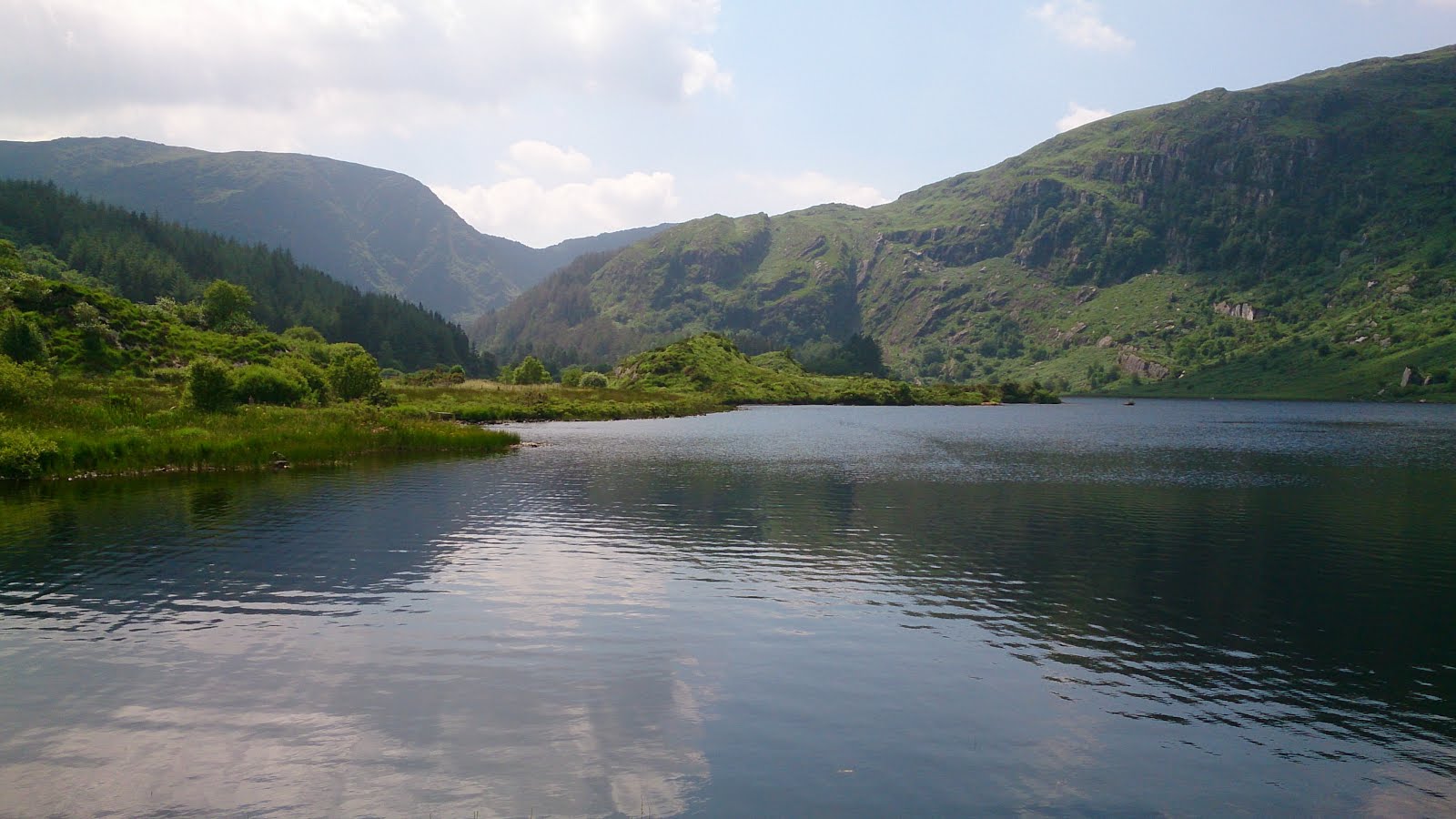
The view from the causeway to the island.
How to find it.
From Cork, the easiest route is to go out the N22 taking the R584 (to the left). Follow this road out until you see signs for Gougane Barra. It is quite a journey on a winding country road. On arrival at the site walk down the lake edge towards the causeway out to the island. the holy well is on the right at the start of the causeway. The enclosure of cells and the church are all on the island.


