Showing posts with label monks. Show all posts

Friday, August 19, 2016

Saint Finbarr's Holy Well, Gougane Barra


Gougane Barra

Right on the border with Kerry the River Lee makes its picturesque appearance surrounded by the shelter of high hills and steep slopes to emerge as the great river that takes many turns and floods into loughs and lakes and pools before it finally flows through the centre of Cork city and out to sea. The life of Finbarr has the same meandering quality with its twists and turns through historical reference, ecclesiastical politics and even recent folklore. Untangling all the threads is not an easy prospect and some have more recently suggested that almost nothing can be said of this saint, so enriched by the numerous layers and patina of successive myths. Some have even suggested that Finbarr is completely mythical in character with no historical basis other than a re-appropriation of the cult of Saint Finnian of Moville [Movilla] (on the outskirts of Newtownards) for the purposes of a new locale. If this is the case, then he is one and the same with Saint Finnian who began life on the west coast of Britain, who moved to Moville to become a renowned scholar, who had an association with Britain's earliest historian (Gildas) and who (according to Adomnán) instructed Saint Columba as a young man. So is Finbarr really Saint Finnian; one and the same person?

The enclosure with central cross and cells at Gougane Barra

It is almost impossible to answer that question as so little of the ancient sources of the Life of Saint Finbarr survive. The issue is further complicated by ecclesiastical politics in a time of considerable church reform, involving the Bishop of Cork who was trying to regain his control of the Diocese of Ossory around 1200AD and whose predecessor had birthed the problem after the surprising loss of the diocese at the Kells-Mellifont synod of 1152. The Life document has an unusual obsession with Ossory sites and churches, linking them to the Diocese of Cork and fronting the saint as a uniting factor. It is possible to read the document in terms of a political tract and an attempt at re-uniting a diocese through a cult surrounding a local saint. The original written Life is lost and may only have been available in a written form as late as 1100. What we do have are a number of Life documents in which the hand of an editor or redactor can be seen and which have occupied scholars for many years. Rather than plough further into this issue and incur the wrath of the Rebel County, we shall instead take a look at Finbarr's holy well in the context of his Life document and in terms of the site and geography in which it resides and as we shall see, there may be some challenges to the idea that Finbarr is Saint Finnian in a new wrapping!

Interior of the nineteenth century church

Finbarr is said to have been born around 550AD near the town of Bandon in County Cork and to have studied in Ossory. On taking the tonsure, the monk cutting his hair is said to have remarked that his hair was very fair and Finbarr was the name given to him and may be a play on words for 'fair headed'. He then takes a journey to Rome with a number of other monks, stopping on his return to receive further instruction from Saint David in Wales. On returning to Ireland he lived a solitary life on a small island in Gougane Barra, before moving from here to live a settled life for a period in the Great Marsh of Munster (now Cork city). Here he gathered a band of monks to form a community and built a church which is now Saint Fin Barre's Cathedral. From here he appears to have travelled through County Cork to collect various saintly relics, almost as a tribute to the establishment of the churches in the Great Marsh of Munster (now a collection of small churches and not only one). It is in the process of one of these journeys that he falls ill, receives the Eucharist from the hand of Fiama and dies the same day. His remains were returned to Cork and he was buried in the churchyard. His grave today is incorporated into the ambulatory of Saint Fin Barre's Cathedral, topped with a large inscribed flagstone directly behind the high altar.

Saint Fin Barre's Cathedral, Cork city (image courtesy of the cathedral website)

The Life document of Finbarr is as remarkable as any other document of its type and time. It is full of stories of miraculous beginnings, of words spoken from the womb, miraculous healings of the deaf, the dumb and the blind and even stories of resurrection by the sprinkling of holy water from a well. The saint is also said to have had the touch of God and as a result his permanently glowing hand had to be forever kept in a glove. On the day of his death the monks prayed to have a little while longer with him and through their intercession the sun did not set for twelve days before his death! Today he is the patron saint of the city of Cork with a grand cathedral in a French Gothic style with its famous trumpeting angel of judgement on the roof of the sanctuary. You can see a fine carving of Finbarr as a Bishop high in the nook of Ireland's tallest cathedra in the cathedral chancel, with a relief of his face carved in the side. A considerable number of saints arose from his foundations and the establishment of the city of Cork owes much to his memory and influence. But it isn't only in Ireland that Finbarr makes a mysterious appearance and this may form part of a rejection of the idea that he is merely a local reincarnation of Finnian. Saint Finbarr appears in a number of places throughout Scotland and local tradition about the saintly dedications claim to have their root in Ireland. The most notable of these is on the island of Barra which sports an ancient church ruin dedicated in his name. We also know that some Scottish breviary had a liturgical form of the Life document incorporated into them, the only surviving one being the Breviary of Aberdeen (1509AD).

Cross inscribed slabs in the cells, inscribed by modern pilgrims.

Personally I would lean more heavily to the idea of Saint Finbarr as a historical figure in reality and not a re-appropriated saint for a local people. While there isn't much sure evidence of this, I find the argument that the Life document has a commonality with the history of Saint Finnian to be somewhat unconvincing and I would place more trust in the oral tradition than most would probably dare. Finbarr's Life has undoubtedly been appropriated for various means throughout time, but for me the sheer strength of his cult and its geographical spread hint at a real historical figure.

Inscription on the plaque of the central cross in the enclosure.

Gougane Barra, where Finbarr spent time in isolation, is a very beautiful and peaceful place. The island is quite small, but the site is well protected from the elements and is frequently visited. It has a tiny nineteenth century church that today is very popular as a venue for weddings. A square enclosure houses a number of cell structures and a large cross in the middle proclaims that one is the original cell of Saint Finbarr. In reality the whole structure is an early eighteenth century reconstruction by a priest called Fr Denis O'Mahony who retreated to the island and spent a considerable amount of time there. It is quite possible however, that some manner of cell structure existed here whether connected directly to Saint Finbarr or not and it has been reincorporated into the present enclosure. During the worst of the penal times the island became deeply significant for Roman Catholics as a place where mass could be celebrated in peace and without the threat of repercussion. 

Saint Finbarr's Holy Well.

The holy well is still visited, although these days mainly by tourists who throw coins into it despite the signs that ask them not to. It is a basic square stone structure right on the side of the lake, topped by a large flat stone and a mound of grassy earth. Local legend has it that when Finbarr arrived at Gougane Barra a great serpent lived in the waters of the lake and he cast it out. As it fled the scene its great bulk carved a channel in the earth all the way to the sea, thus creating the River Lee. It is best to visit the site early in the morning or late in the evening as it can become very thronged with tourists and very noisy with wedding parties. The Saint Finbarr Pilgrim Way is also a good way to visit the well and site. It has been recently revived and takes place each year on the saint's feast day (25th September) from Drimoleague to Gougane Barra; although you can walk the trail at any time of year. Gougane Barra also has a number of walks with many species of trees to see and beautiful scenery and some deer if you're lucky. It also boasts Ireland's top toilet!

Ireland's top toilet!

He was the clear well through which the sins of all the people entrusted to his care by God were washed clean by the purity of his teaching.
Portion from the early vernacular Life 
(transl. by Pádraig Ó'Riain, Irish Texts Society).
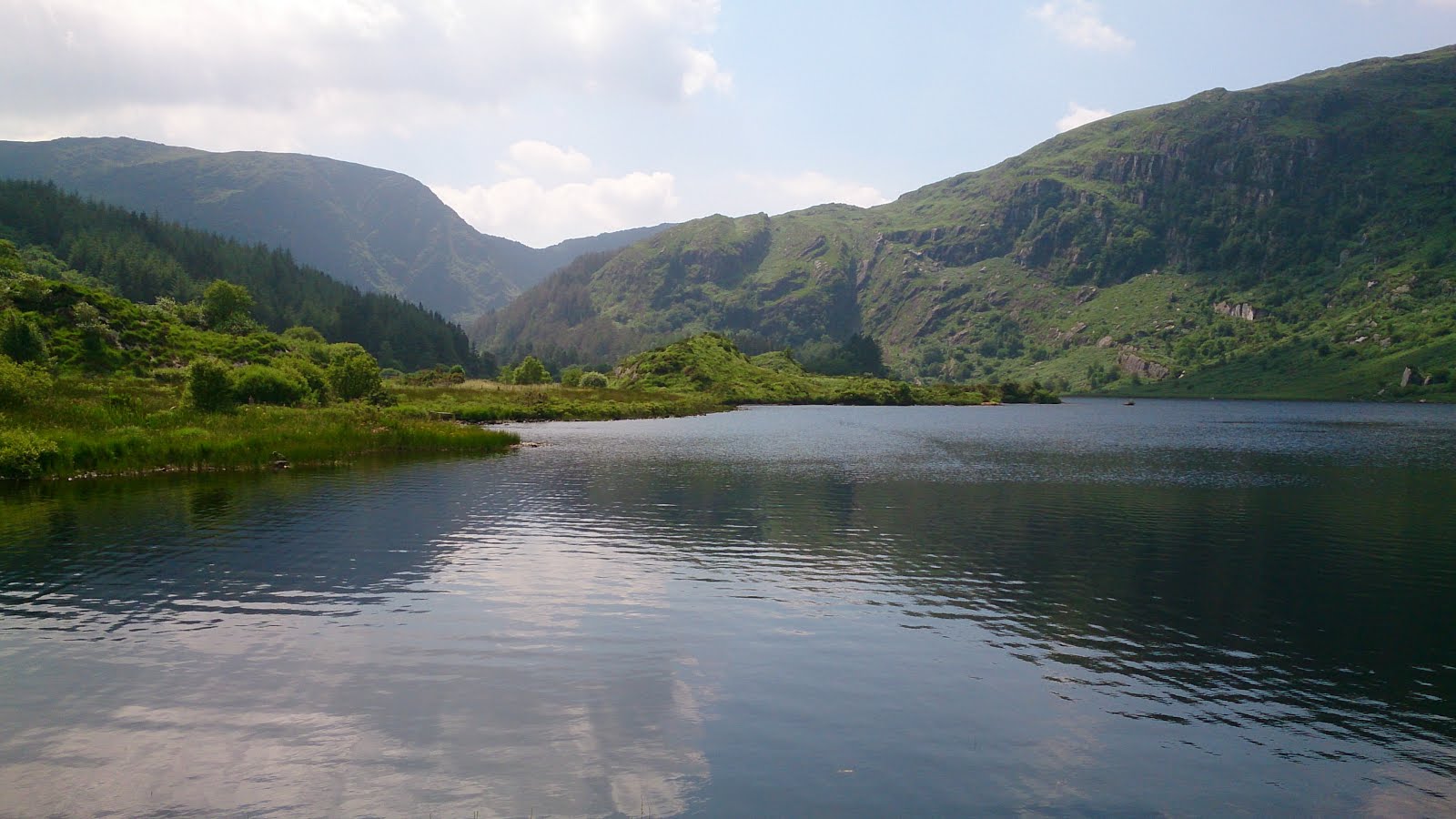
The view from the causeway to the island.

How to find it.
From Cork, the easiest route is to go out the N22 taking the R584 (to the left). Follow this road out until you see signs for Gougane Barra. It is quite a journey on a winding country road. On arrival at the site walk down the lake edge towards the causeway out to the island. the holy well is on the right at the start of the causeway. The enclosure of cells and the church are all on the island.

Thursday, November 28, 2013

The Holy Well At Reask, County Kerry

Gallus Oratory


The Dingle peninsula boasts a huge number of impressive archaeological sites. You can almost stand in one place and throw a stone to hit the next one. As you travel through them it is easy to become overwhelmed and unable to take it all in as you move from the Iron Age to very early Christianity to the Late Medieval period all in the space of about thirty minutes. It is part of the problem of trying to visit a place like the Dingle peninsula in a few short days. It rewards repeat visits and an opportunity to spend time lingering at sites, rather than rushing through them. I began my day at Gallus Oratory; a fine, stone-built church in the early Irish style and quite possibly Ireland’s most famous building. It is somewhat difficult to date for a number of reasons: excavation has uncovered no evidence regarding its possible use, mortar is entirely absent from the stones that form the building and nothing was found inside it, but estimates suggest that it was built at some point between the 6th and 9th century. The name is a little curious too -  ‘Gallus’ can be translated as ‘place for the foreigner’ – but it may have been a stop for pilgrims as they made their way to the famous route towards the top of Mount Brandon.

The monastic site wall

Not far from here, although further in from the coast but not out of sight of it, is the monastic site of Reask (Riasc). This site was carefully excavated by Tom Fanning between 1972 and 1975. The outer walls of the site are still marked very clearly and there are a number of remains of beehive huts (Clochans) and a church. It’s not a huge site, but it is not insignificant either. It dates to around the 6th century, but we know absolutely nothing of its founder or occupants, other than they were Christian.

The large cross

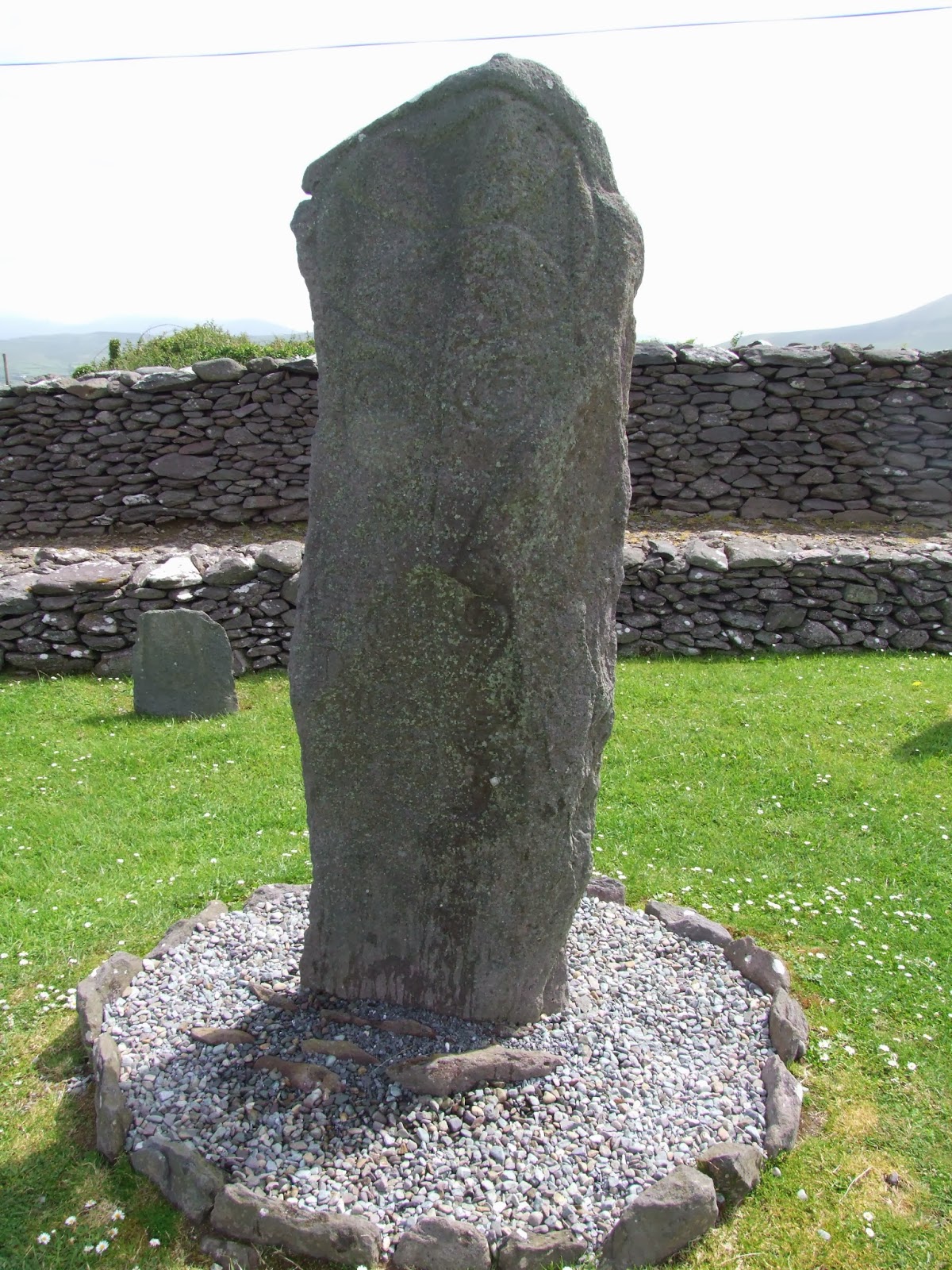
Reask’s walls housed three crosses. One cross is on a stone slab in the Latin style with two small crosses either side of it; likely a reference to the two thieves crucified either side of Jesus. The other cross is very small and now quite badly weathered. On the front it has the letters DNO and on the back it has the letters DNI. The third cross is by far the most impressive being just over one and a half metres tall with a Mediterranean style cross inscribed and ending terminals in the famous La Téne form of Celtic art. It is suffering a little from its exposure to the weather, but none the less imposing for it. Down it’s side are the barely legible letters DNE, thought to represent the simple plea, ‘O Lord’.

The holy well

The whole site is slightly raised from the surroundings, but the whole area is generally quite flat. The site was abandoned quite early on and turned into a graveyard for children, whose graves are marked with quartz stones. Towards the back of the site is the holy well. Sadly, we know no saint associated with this site - in fact there may never have been one – but this well would have been used by the community for many purposes, both ritual and practical. Today sadly, it is dry.

The view from the site to the Three Sisters headland

Although it may have been a small site, maybe housing around ten monks, it is clear that they were not without ability. The largest cross is finely carved and archaeological evidence points to trade with the Mediterranean an a number of other cross inscribed stones are on display in the Músaem Chorca Dhuibhiine in the nearby village. I was able to spend a little time here in the heat of the summer sun and I could see why the monks settled this site. It was sheltered and incredibly quiet, disturbed only by the occasional bee going about his work.

Full view of the large cross

You are the peace of all things calm
You are the place to hide from harm
You are the light that shines in the dark
You are the heart’s eternal spark
You are the door that’s open wide
You are the guest who waits inside
You are the stranger at the door
You are the calling to the poor
You are my Lord and with me still
You are my love, keep me from ill
You are the light, the truth, the way
You are my Saviour this very day.
Early Irish prayer (oral tradition)


How to find it:
From the town of Dingle make your way along the Ring of Dingle and the site is clearly marked. You will travel inland a little from the Three Sisters headland and travel up a narrow track road. The site is hidden just over the rise.

Friday, May 24, 2013

Saint Doolagh’s Well, Malahide, Dublin.

The Exterior Baptistry

Malahide has been a populated area for a considerable length of time with remains of much prehistoric activity, then settled again very considerably by the Vikings in the late eighth century, before finally becoming a rapidly growing suburb from the 1960’s on. The village of Malahide has a holy well of its own on the old main street, dedicated to St Sylvester, but today it is covered up and there is no access. A pattern day used to be observed at this well in honour of the Blessed Virgin Mary on 15th August.

 View of the Original Church with the Victorian Extension to the rear
 
The church of Saint Doulagh is a fair bit out from the village in what must have been an isolated area at one time and today is a marriage of a twelfth century structure and a Victorian chapel. As you approach the church the tower and the the front portion are the original structure, which includes a double stone roof, a few ‘cells’ and a couple of rooms of quite small proportions. It is possible that the two small rooms could have been a refectory and dormitory for monks that would have lived on site. Of the monks of the twelfth century we know nothing, but there is some evidence that the site was used continuously by Christian communities dating back to the time of Saint Patrick and it is with a saint closer to Patrick’s time that we will concern ourselves with here.

 The Cross

Saint Doolagh (Doulagh in the church spelling, Dúileach in Irish) was an anchorite living on this site. At the church there is the twelfth century structure, the newer church, an ancient baptistry (outside) and a pond or well. Engravings from the eighteenth century show a stone circular structure to the front of the church and close to the baptistry, but no trace of this now remains. Inside the twelfth century structure of the church, one of the rooms incorporates a tomb, which throughout it’s history has been understood to be the tomb of the saint. The anchoritic life was one of the earliest forms of Christian monasticism, common among early Christians throughout the Middle East, most famously in Egypt. It was an extreme lifestyle of little comfort, constant prayer, minimal food and water and intense concentration. It was carried out in solitude where possible with a considerable focus on the importance on the Eucharist as the principal act of worship. While there is evidence that the anchoritic life was fairly common among early Christians in Ireland, it was curiously not the case in Britain, which did not see the rise in popularity of this charism until the late Middle Ages. Saint Doulagh’s life must have been hard, unrelenting in it’s challenge and fraught with a certain danger too. 

 View of the church

Very little else is known of Saint Doulagh. He appears in the ancient Calendar of Christ Church Cathedral as ‘Episcopus et Confessor’ (Bishop and Confessor) and his patronal day is listed as the 17th November (although this may be a change from an original festival date of 1st August). He features hardly at all in any other hagiographical literature in Ireland, or indeed Europe. His lineage is preserved in various documents and some documents speak of his ‘bed’ being a place where pregnant mothers would lie and say prayers for a safe birth. His history (in the form of a Saint’s Life) was said to have been preserved at the site up until the seventeenth century when it was destroyed, an event that might have corroborating evidence in the destruction of the baptistry too. Despite his obscurity now, he must have been famous even in his day, as he is listed as one of the saints invoked in the ceremony as a guarantor of the Law of Adomnán.

 The holy well

The holy well is in the middle of the only exterior and detached baptistry in all of Ireland. It is a large circular hole in the centre of an octagonal structure with a pool to the rear. The well is sadly dry, some citing the expansion of the nearby road as the cause, but recent reports suggest that after two horribly wet summers that water has surfaced! The well originally drained out into the pool to the rear, known as Saint Catherine’s pool. It is thought that the baptistry was for the baptism of boys, whereas the pool was for the baptism of girls, but it is more likely that the pool is for adult baptism by full immersion. The baptistry was plastered and decorated by a local resident (Peter Fagan) at great expense in 1609, with fresco paintings of Saint Patrick, Saint Doulagh, Saint Brigid and Saint Columba, with a central overhead fresco of the descent of the Holy Spirit upon the Apostles. A large marble plaque also bore the inscription: 'Bethesda's sacred pool, let others tell, with healing virtues, let her waters swell. An equal glory shall Fingallia claim, not be less grateful for her blissful stream. Thy prayers, Doulachus, mounted up to He'ven, thence to thy will the mighty power be given, to drive the fiery fever away. Strength to replace and rescue from decay, in every malady a life to stay. The cherub, wondrous, moves his wat'ry sphere. The Saint beholds, who stirs the fountain here. Hail, lovely fount! If long unsung thy name, it thence shall rise above the starry frame.' Sadly, these were all completely destroyed  by Sir Richard Bulkeley of Dunlavin on his return from the Battle of the Boyne, and it is possible that he destroyed the Saint’s Life at the same time.

 The pool of St Catherine


The site also contains a small granite cross in a latin type shape with flayed edges. The stone is not native to the area and must have been brought in from elsewhere, possibly as part of another site. Dating the cross is somewhat difficult, but it is possible that it dates to the period of the original church and monastic settlement that still exists as part of the church today. Despite the dryness of the well, a patronal service for Saint Doulagh is still held today along with ecumenical gatherings, but no pattern has been observed here since the end of the eighteenth century.

 View of the baptistry

Lord Jesus Christ, Son of God, have mercy upon me.
The Prayer of the Heart in the Orthodox tradition
(dating back to the Desert Fathers.)

 To the rear of the baptistry

How to find it:
This is an easy site to find. Travel up the Malahide Road (R107) and you will see the church on your left. The cross stands at the entrance and the baptistry is to the right of the church.