Showing posts with label Dingle. Show all posts

Monday, September 29, 2014

Saint Maolcethair's Well, Kilmalkedar.

Kilmalkedar monastic site

Legend holds that this church and site was built by Saint Maolcethair (Maol Céadair or Maol Céaltair) and Saint Brendan some time in the mid to late 500's. It is a beautiful site that lies in peaceful repose at the foot of Mount Brandon on the Dingle peninsula not far from the Reasc settlement. In fact, this is where the newly signposted route for the turas, or pattern, begins which normally takes place on the 29th June. The feast day of Saint Maolcethair is 14th May. 

A Tau cross with an inscribed Latin cross

The site is littered with all manner of antiquities, including ancient crosses (including one that looks like it may be an unfinished decorated cross), ballaun stones, an old sun dial, some collapsed underground passages, a church and a number of grave slabs and ogham stones. The church itself is an ancient foundation with a twelfth century nave attached. The original church looks somewhat similar to the nearby Brendan's Oratory, but parallels have also been drawn with Cormac's Chapel in Cashel. 

The Alphabet Stone (Latin inscription on the left hand side)

The church houses a small cross and a large grave slab with a Latin inscription down the left hand side. It is thought that the first three letters represent the word 'Domini'. The ruins are an impressive size, but the original church would have been considerably smaller. The chancel and sanctuary were added in the twelfth century. The church is a good example of the Romanesque style, with an impressive doorway and a number of carved heads that have been reasonably well preserved.

The sun dial

Despite his lengthy and impressive genealogical lineage, very little is known of Maolcethair. He was originally from Ulster and the martyrology of Donegal lists his date of death as 636 AD and his lineage stemming from a previously unknown or unlisted Ulster King. Only one small fragment of story exists about his arrival in the area. On arrival from Ulster he undertook to settle the area and learnt of the ways and religious thoughts of the local people who believed in impersonal or ambivalent deities who inhabited the sea and the sky. His message of a single unified and personal  God was apparently well received! His name is slightly peculiar in that it is thought to be a pun relating to the cross of Christ. A legend tells of the cross of Jesus been hewn from a cedar tree and Maolcethair's name incorporates the Irish word for 'cedar'. It may -  at a stretch -  explain the preponderance of crosses on the site!

The well

The holy well is across the road, opposite the monastic site. In the middle ages this site was quite considerable, and wealthy too, being subject to the papal tax. A two-story stone late medieval dwelling was erected (possibly to house clergy and monks) and the well has been incorporated into the side wall at the very front of the house. It has a good flow and runs off through a stone carved channel into an underground culvert with worn stone steps leading down to it. It would appear that some of the original structure of the well has been preserved or re-used when the house was built.

The ogham stone

Almighty God, who in the passion of your blessed Son made an instrument of painful death to be for us the means of life and peace; grant us so to glory in the cross of Christ that we may gladly suffer for his sake; who is alive and reigns with you, in the unity of the Holy Spirit, one God, now and for ever. Amen.

Detail of the Romanesque doorway

How to find it: The site is very clearly signposted from the ring of Dingle around the peninsula. It lies at the foot of Mount Brandon and is the starting point for the trek up to the top of the mountain. The holy well is at the left hand corner of the ruined house across the road from the site.

A view out over the mountains in Dingle.

Thursday, November 28, 2013

The Holy Well At Reask, County Kerry

Gallus Oratory


The Dingle peninsula boasts a huge number of impressive archaeological sites. You can almost stand in one place and throw a stone to hit the next one. As you travel through them it is easy to become overwhelmed and unable to take it all in as you move from the Iron Age to very early Christianity to the Late Medieval period all in the space of about thirty minutes. It is part of the problem of trying to visit a place like the Dingle peninsula in a few short days. It rewards repeat visits and an opportunity to spend time lingering at sites, rather than rushing through them. I began my day at Gallus Oratory; a fine, stone-built church in the early Irish style and quite possibly Ireland’s most famous building. It is somewhat difficult to date for a number of reasons: excavation has uncovered no evidence regarding its possible use, mortar is entirely absent from the stones that form the building and nothing was found inside it, but estimates suggest that it was built at some point between the 6th and 9th century. The name is a little curious too -  ‘Gallus’ can be translated as ‘place for the foreigner’ – but it may have been a stop for pilgrims as they made their way to the famous route towards the top of Mount Brandon.

The monastic site wall

Not far from here, although further in from the coast but not out of sight of it, is the monastic site of Reask (Riasc). This site was carefully excavated by Tom Fanning between 1972 and 1975. The outer walls of the site are still marked very clearly and there are a number of remains of beehive huts (Clochans) and a church. It’s not a huge site, but it is not insignificant either. It dates to around the 6th century, but we know absolutely nothing of its founder or occupants, other than they were Christian.

The large cross

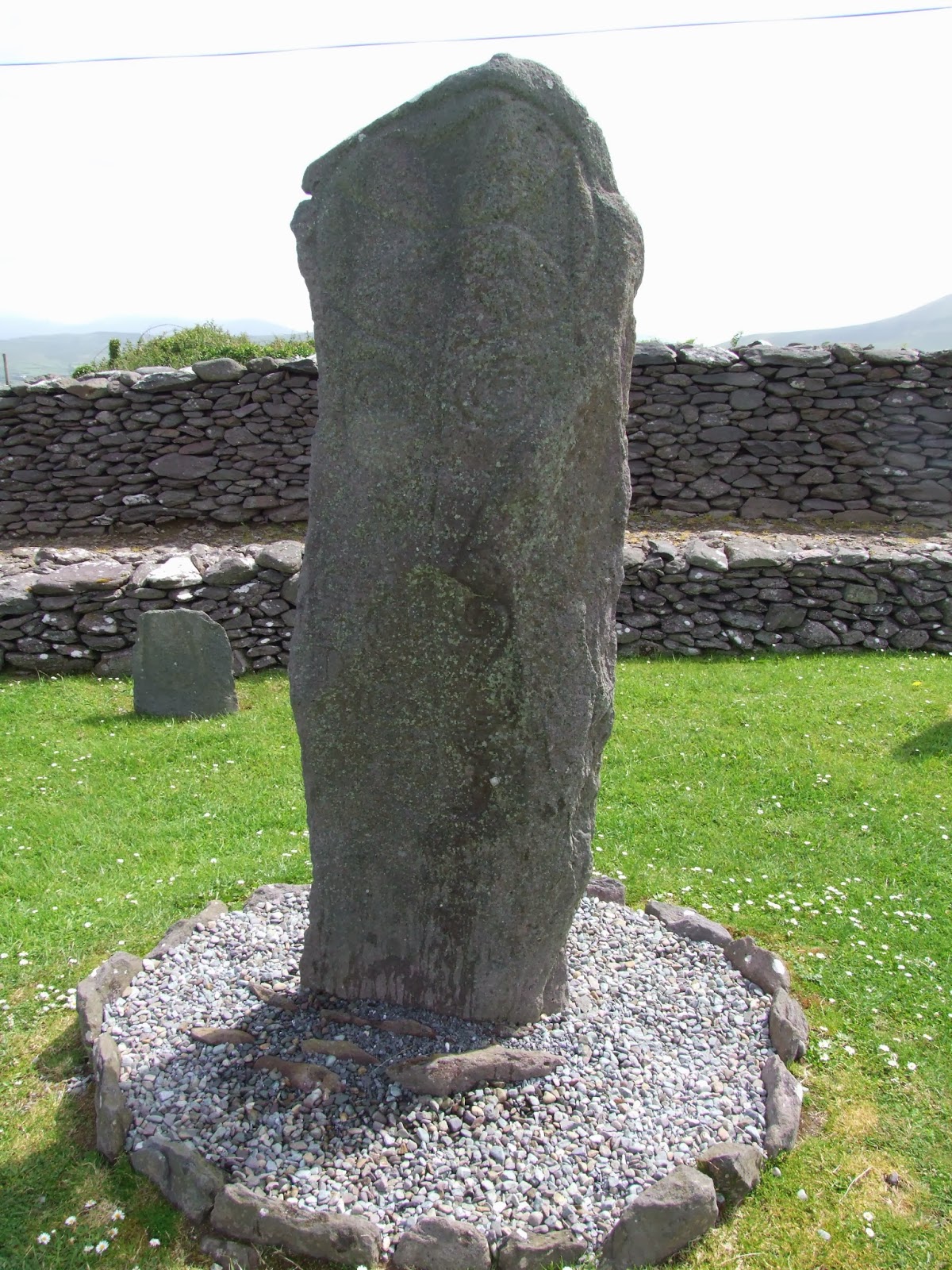
Reask’s walls housed three crosses. One cross is on a stone slab in the Latin style with two small crosses either side of it; likely a reference to the two thieves crucified either side of Jesus. The other cross is very small and now quite badly weathered. On the front it has the letters DNO and on the back it has the letters DNI. The third cross is by far the most impressive being just over one and a half metres tall with a Mediterranean style cross inscribed and ending terminals in the famous La Téne form of Celtic art. It is suffering a little from its exposure to the weather, but none the less imposing for it. Down it’s side are the barely legible letters DNE, thought to represent the simple plea, ‘O Lord’.

The holy well

The whole site is slightly raised from the surroundings, but the whole area is generally quite flat. The site was abandoned quite early on and turned into a graveyard for children, whose graves are marked with quartz stones. Towards the back of the site is the holy well. Sadly, we know no saint associated with this site - in fact there may never have been one – but this well would have been used by the community for many purposes, both ritual and practical. Today sadly, it is dry.

The view from the site to the Three Sisters headland

Although it may have been a small site, maybe housing around ten monks, it is clear that they were not without ability. The largest cross is finely carved and archaeological evidence points to trade with the Mediterranean an a number of other cross inscribed stones are on display in the Músaem Chorca Dhuibhiine in the nearby village. I was able to spend a little time here in the heat of the summer sun and I could see why the monks settled this site. It was sheltered and incredibly quiet, disturbed only by the occasional bee going about his work.

Full view of the large cross

You are the peace of all things calm
You are the place to hide from harm
You are the light that shines in the dark
You are the heart’s eternal spark
You are the door that’s open wide
You are the guest who waits inside
You are the stranger at the door
You are the calling to the poor
You are my Lord and with me still
You are my love, keep me from ill
You are the light, the truth, the way
You are my Saviour this very day.
Early Irish prayer (oral tradition)


How to find it:
From the town of Dingle make your way along the Ring of Dingle and the site is clearly marked. You will travel inland a little from the Three Sisters headland and travel up a narrow track road. The site is hidden just over the rise.

Thursday, August 1, 2013

Tobar Nano, Díseart, Dingle.

Dingle Harbour

Díseart in Dingle sits in the centre of the town; a former Presentation Convent, now a centre of Celtic Studies to promote the Irish language, culture, archaeology and the arts. Dingle (or An Diangean Uí Cúis -  meaning town of the fort) was formed as a port town in the mid to late twelfth century during the Norman invasion of Ireland and by the thirteenth century was a thriving town with a huge amount of exports leaving through the port that rivaled other nearby cities. By 1569, Dingle was one of the fifteen or so towns given the monopoly on the importation of wine to Ireland. The town was also greatly helped in its development and wealth by the strong connections with Spain; this was considered to be the port to leave through if you were making the pilgrim journey to Santiago de Compostela. This link was further cemented by the local church being dedicated to Saint James. However, by the end of the sixteenth century, Dingle's fortunes began to turn. The town was sacked and burned a number of times and trade began to dry up. For a short period the linen industry looked like it might turn around the misfortunes of the town, but by the 1830's the industry that held so much hope for many simply ground to a halt. The famine years were most unkind to Dingle and were compounded by a terrible cholera outbreak which threatened to destroy the town completely. By the end of the nineteenth century its fortune revived as the fishing industry brought it new life and the birth of tourism in the mid twentieth century has ensured its survival and prosperity ever since.

Dingle is small and beautiful town with much to do and see. In the high season as many as twenty thousand people can pass through the town in any given week, taking boat trips in the hope of seeing Fungi the dolphin or to the Blasket Islands, or touring around the area to see the many archaeological sites, the beautiful scenery or to climb Mount Brandon. In the centre of the town sits a large Roman Catholic Church dedicated to the Blessed Virgin Mary, built in 1869. Beside it is the neo-Gothic structure Díseart.

A view of Díseart from the gardens

Díseart is a large and imposing building and a former Convent of the Presentation Sisters which includes a chapel dedicated to the Sacred Heart and surrounded by grounds which have been transformed into gardens representing the Tree of Life. The chapel is part of the main building on the second floor. Originally it was somewhat plain, but under the direction of Mother Ita Macken in the 1920's it was refurbished to create a truly wonderful space. At a cost of £1000, she commissioned Harry Clarke to produce a set of six windows depicting the life of Christ. Sadly, photographs are not permitted in the chapel (although I did sneak one!), but the Harry Clarke windows are truly very impressive. Like much of Clarke's glass it is very difficult to photograph because of the intensity of colour and changing light. It's always better to see them in person to truly appreciate their beauty and depth.

Detail of the Adoration of the Magi

Díseart also houses a set of modern fresco's by Colorado born artist, Eleanor Yates. I can't say I'm a fan. Some find them inspiring and beautiful, but personally I found them gaudy and a bit overpowering. They depict the life of Nano Nagle, the founder of the Presentation Sisters in 1775. Nano Nagle was born in Cork and sent as a child to be educated in Paris. From a wealthy Catholic family she enjoyed the opportunities of a good education, but even while in Paris she noted the plight of the poor and their lack of education. On returning from Paris she lived with family for a while in Dublin, but after the death of her parents and her sister in quick succession she joined the Ursuline
Convent in Australia. Here she became convinced that her services would be better employed in the service of her own people in Ireland, where many suffered educational and financial poverty due to the enforced penal laws. On her return to Ireland she set up her first order dedicated to the Sacred Heart which later became known as the Order of the Presentation Sisters. Her first school for the poor was established in Cork city and soon she had a collection of seven schools throughout the city dedicated to the education of the poor. Nano was tireless in her efforts and was often criticised for neglecting her own needs and her own health. Finally, her over worked and stressed body gave up and she collapsed on Cross Street in Cork, dying soon after in 1784. Her life was to continue to inspire many people for decades. Her schools still exist and provide education for all and her order has spread throughout the world, still having a concern for, and working with the poor and needy.

The Presentation Sisters graveyard in Díseart grounds

The holy well in Díseart grounds was neglected for a long period of time and pretty much forgotten about. Some sources indicate that it was dedicated to the Blessed Virgin Mary (which would make sense with a church of the same dedication and residing in a Presentation Sisters Convent grounds), while others suggest a dedication to Saint Peter, which would certainly be unusual in Ireland. Whatever the case, the true dedication of the holy well was forgotten. It was a very deep well and today, little or nothing of its original structure survives. In fact, it as only very recently rediscovered. In 2009 a celebration of Nano Nagle's life took place at Díseart, and the well was fully restored. After a mass in the chapel, and during a reception in the gardens, Monsignor Pádriag Ó Fiannachta blessed the newly restored well and dedicated it to Nano. The restoration has been done well, but access to the water is impossible.

Tobar Nano

The grounds around the former convent are beautiful and well worth a visit. There are places to sit and be quiet and still in lovely surroundings, along with groves of trees and winding paths away from all the hustle and bustle of the town. The large tree at the top of the gardens holds some clouties. The Catholic Church of Saint Mary next door to the convent is also worth a visit. It is quite plain inside by comparison, but presents a still and peaceful spot.

Interior of Saint Mary's Church

Loving God, you made us in your image. Forgive us when we we fail to see your image in each other, when we give in to greed and indifference to the world's poor and needy, when we do not question the systems that are life-denying. As we are made in your image, let us live in your image and be Christ-like, in service, endurance and love. 
Amen.

The tree at the top of the gardens

How to find it:
Díseart itself is easily found in the town of Dingle. From the old convent, head up the left hand side of the gardens and the well is about half way up against the wall. It's hard to miss -  it has a large slate fixed above it which reads, 'Tobar Nano'.