The Shrine of the Cathach of Saint Columba
Saint Columba
(Colmcille) is a saint that is shrouded in mystery and legend, yet is counted
as one of the twelve apostles of Ireland. Of his early life in Ireland we know
very little, whereas his later life is documented by Adomnán. The only thing we
can say for certain are that he was of a royal lineage, that he became a monk
and cleric in Ireland and that the synod of Teltown declared him to be
excommunicated. St Moilasse was employed by Saint Columba to intervene and make
a case to the synod, who then withdrew the pronouncement of excommunication on
the condition that Columba leave Ireland and never return. We can say little
else for certain, and yet in Ireland stories abound about him. Ireland’s oral
lore suggests that Columba was born at Gartan, established monasteries up and
down the land, created the Book of Kells, was a man of peace and reconciliation
and established his most important monastery at Kells in County Meath. None of it
can be verified for certain, but some of it is most certainly not true.
Firstly, Columba was no man of peace when he was in Ireland. There are records
contemporaneous to him that describe him as man who was excited by warfare and
whose temper was best not roused. During his time in Ireland an important
battle was being fought regarding the succession to the throne and there have
been suggestions that he was directly and personally involved, but again, we
cannot be certain. Secondly, the Book of Kells was most certainly written after
Columba’s death, so he could not have been personally responsible for it.
Modern scholars suggest that it was a book created in his honour, possibly
created specially for the two hundredth anniversary of his death. Whatever the case
the book did have an association with Kells, but this was around the year
800AD, after the monks had more or less fled Iona with relics and books and
distributed them between Ireland and Scotland - some of the remains of the saint having been disinterred and
divided between Ireland and Scotland. Thirdly, there is an issue with Gartan
being the place of his birth. Gartan was not declared to be his place of birth
until some time after his death, and some - even at the time – have poured scorn on the idea, saying
that it is a claim to fame rather than an attestation of truth. And lastly,
Columba did not settle monasteries in Ireland. While he was on Iona he did use
his monks for political means -
albeit for the furtherance of God’s kingdom rather than his own - and he sent them to various places that
required help in building, in mission and in copying the scriptures and
farming. It is in this way that the sites have an association with Columba, but
really nothing more.

The unfinished cross and the round tower
The town of Kells
claims that Columba settled it as a monastic site, but this is highly unlikely.
Columba doesn’t appear to have been considered a great man while in Ireland (at
least in religious terms), so it is unlikely that he would be put in charge of
of a significant monastic settlement. It isn't really until he is exiled that
he becomes the man God meant him to be. There have been many debates as to why
Columba left Ireland and why the Teltown synod declared him excommunicated, but
his past and his royal lineage might hold the clue. It appears that the battle
of Cúl Dreimhne in 561AD concerned the right of two rival kings to the
accession of the throne, and Columba appears to have used his influence as a
monk and cleric to further the cause of his own favoured royal to be. The synod
of Teltown talks of him abusing his position and influence, and it might be
that this is what they are referring to. In any case the final result is that
the excommunication is lifted, but he must leave Ireland for good. He remains a
little while and then finally sails to the small island of Iona; south of the
famous Fingal’s cave and north of the great whisky giants of Jura and Islay. Here he
establishes his monastic settlement that was to take on primary importance in
Scotland, and have an influence too on Ireland. Columba and his monks said the
daily offices of the church, farmed the land, copied the scriptures and
received penitents on the island. But Columba also journeyed throughout much of
Scotland, giving encouragement to other religious settlements and acting as a
kind of diplomat between them and the leaders of the Picts, who were not always
greatly welcoming to monks. Over time, and shortly after his death, he became
known as a man of reconciliation and peace. He appears to have wrestled with
his demons and won, and whether they knew it or not, the decision of the monks
at the synod of Teltown was maybe a wake up call to Columba as well as the
beginning of the creation of a saint.

The market cross
The original name
of kells was Ceanannas Mór, meaning the Great Fort and being an important royal
seat. But by 804AD it was to become a significant monastic centre. We don’t
know exactly when the monastic site was established at Kells or by whom, but we
do not that it grew significantly when the monks from Iona arrived after their
great flight from the island some time just before 804AD. It is an impressive
site, even in its ruined condition today. It was originally a site composed a
double circle with the inner circle having the church (which no longer
survives), a small stone roofed oratory and the round tower and five impressive
carved crosses. The round tower dates to the tenth century and today it is
missing it’s conical roof. It had six floors with access probably by ladders,
impressive inner carvings and a window for each floor, except for the sixth
floor which have five windows. It is thought that these five upper windows
represent the five main access roads into the town.

The South Cross
The stone roofed
survives, and today it is called Saint Columba’s house. It may have been used
by the monks to say their offices or possibly be an old shrine church and
burial place for the founding abbot. It is well preserved, although availability
of access varies depending on when you go. It was known at one time to have
housed a large flat stone called Saint Columba’s bed, reputedly brought by the
fleeing monks from Iona by currach. It may not have been his bed at all, but
simply a suitable grave slab from Iona that the monks had fashioned in
preparation for the interring of his divided remains in Kells. As it happened,
his partial remains were placed in a highly decorated shrine and later
transferred to the shrine of Patrick to rest alongside Saint Brigid’s remains
in Downpatrick. The Annals of the Four Masters and also some old ordinance
survey maps refer to a secret tunnel running from this oratory to the old
church, but today it has yet to be found.
Saint Columba's House
The present
church on the site is a Church of Ireland parish and is somewhat uninspired.
Beside it sits a old church tower, rebuilt many times and having broken
carvings, cross slabs and carved heads incorporated into its walls. Close by ,
the old font sits under a yew tree and the foot of a high cross is the only
remaining part of one of the five great crosses. One of the crosses has been
moved from the site altogether. When the new church walls were built for the
Church of Ireland parish, it split the original design of the site to
accommodate new roads through the town which left one impressive cross in a
precarious spot beside traffic. It has recently been moved down to the front of
the town and is protected slightly from the elements with a plastic canopy. The
market cross is made from sandstone and has a fluidity of carving that is
astonishing. Its base has a hunting scene and two centaurs. Many have said that
it is merely a playful scene and nothing more, but it could be a representation
of the death of paganism. On top of the broad base sits the cross with carved
panels on all four sides. One side of the cross has the usual new testament
scenes you expect to see on this type of cross, with a scene of the crucifixion
at its centre. But the other side of the cross hold a bit of a surprise. It
begins with the soldiers guarding the tomb and rises to what you would expect
to be a scene of the resurrection of Christ, but what we get instead is Daniel
in the lion’s den. This is an enormous cross, but sadly it has been broken.
Like many other crosses of this type, it would once have been highly coloured.

The Shrine of Saint Columba's partial remains (now empty)
In the monastic
settlement there is an imposing, but unfinished cross with a crucified Christ
at its centre. The West cross has been broken, supposedly by Cromwell, and has
some very fine carvings. The base shows the baptism of Christ and the wedding
feast at Cana and on the opposite side are Adam and Eve and Noah’s ark. There
are a few other panels, but they are now too worn to decipher. The cross is of
a much less fluid type of carving, but it it does have some very beautiful
spiral and knot work to the side panels.
Detail of the baptism of Christ from the West cross (broken)
The South Cross
is the only reasonably intact and finished cross on the site and despite being
very deeply incised it is still badly weathered. The person who carved this
cross had a real mastery of their art. The panels are like snapshots, having a
sense of movement and life. It is thought that this cross may have been carved
during the ninth century to mark the safe arrival of the monks from Iona and
the inscription on it’s base dedicates the cross to Saint Patrick and Saint
Columba. The cross is eleven feet high, but missing its top cap stone and it is
carved from one piece of stone. The east side has Adam and Eve, Cain and Abel,
the fiery furnace and Daniel in the lion’s den, topped by the raven bringing
food to Saint Anthony in the desert, the sacrifice of Isaac and the miracle of
the loaves and fishes. The opposite side has Sampson and the lion, David and
the bear, topped by the crucifixion and then Christ in triumph surrounded by
the four evangelists. It appears that the cross has an obsession with animals
and beasts, but it may be that it is depicting the triumph of the human spirit
over animal passions – a suitable theme for Saint Columba.

Carved faces on the old church tower
As I said, the
north cross is completely destroyed, and all that remains of it are a weathered
stump. The reason why there were five crosses is not really known, but it is
likely that they represent the five wounds of Christ. Many of the scenes on the
crosses have striking similarities to images within the Book of Kells which
almost disappeared for good while at this site. In 1007AD the book was stolen
and later found, but its gold cover had been removed and has never been
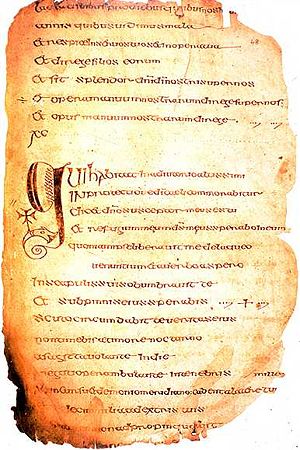
recovered. The site also held other significant relics, one being the Cathach
of Saint Columba and it’s shrine. This was a Psalter copied by Columba near the
time of his death. Adomnán tells us that the night Saint Columba died, the last
verse he translated in the Psalter was from Psalm 34: Come my children, listen
to me and I will teach you the fear of the Lord. The Psalter was completed by
the monks on Iona and is now preserved in the Irish Royal Academy.
A page from the Cathach of Saint Columba
The well of Saint
Columba is a little way out of the town. From the monastic site, head up the hill
on the southern side, cross the road and walk a little further until you come
to an iron gate between two houses with a narrow country lane leading down to
the well. It is clearly signposted from the road and the entrance bears a stone
plaque. The lane winds on a little way before opening up into a small enclosed
area that has been well tended and carefully looked after. The day I visited,
someone had been planting flowers in the bank on the far side of the well. The
well housing is crude and simple, but the area is private and peaceful. The
water is clear and cool and flows steadily down a culvert into a stream in a neighbouring
field.
The lane to the well
Patterns have been
observed at this well for a long time. When you visit the town and it’s various
tourist centres you will see old Victorian photographs of people praying at the
well. Today the pattern is a great event, with the rosary said on the evening of
the 7th June and the Kells Silver Band playing. A mass is then said at the well
on 9th June; a tradition that has been observed in this way since 1843. Concerns
for the condition of the well grew around 2000 and in 2010 the Kells
Archaeological and Historical Society was granted aid from the Town Council and
the goodwill of the landowner to restore it fully - a task that was completed
in 2011.
The holy well of Saint Columba
Antiphon: Let the summits of heaven praise you with roaming lightning; O
most loving Jesus, O righteous King of kings
Father keep us safe under
The tempests and the thunder,
Lest we should be shattered
By your lightning shafts so scattered.
Your terrors while hearing,
We listen still God fearing
To the resonant song
Of the bright angel throng.
As they wander and praise you,
Shouts of honour still raise to you.
To the King ruling right,
Jesus Christ, all love and light.
Filled with God’s grace indeed,
Not with wine or a clear mead.
The precursor; John the Baptist’s word,
Told of the coming of the Lord,
Who blesséd for
evermore
All mankind should
bow before,
Of this saint
begotten from Elizabeth and Zacharia.
May the fire of
your love live within my heart,
As a jewel of
gold in a silver kept vase
Glory to the Father, and to the Son, and to the Holy Spirit;
As it was in the beginning, is now, and shall be for ever.
Amen.
Antiphon: Let the
summits of heaven praise you with roaming lightning; O most loving Jesus, O
righteous King of kings.
Nolie Pater (a canticle composed by Saint Columba)
Detail of the hunting scene from the market cross
How to find it:
In the town of
Kells the monastic site is easily found. From here, head up the hill on the
south side of the site, cross the road and a little way along you will find the
entrance to the well. It is clearly marked and signposted.
Carved knot work on the West cross