Friday, March 1, 2013

Saint David’s Holy Well, Tinakilly, County Waterford.

St David's Cathedral, Wales


Tinakilly is a small hamlet in the peaceful and secluded townland of Woodhouse (not the Woodhouse estate that Michael Jackson once tried to buy!) not far from the village of Clashmore. At it’s heart sits a beautiful holy well dedicated to Saint David, the patron Saint of Wales, whose feast day is the 1st March which marks the day of his death in 601AD.

The statue of Saint David at the well


We know a great deal about Saint David. He was from an aristocratic family in Wales and lived in the sixth century, his mother -  Non – also became a saint and he was educated and instructed in Christianity by Saint Paulinus. He is responsible for setting up a monastic settlement at Menevia, which later became known as Saint David’s in Wales where an impressive Cathedral dating from 1181 now stands and in which sits a newly restored shrine containing his relics. His monastic rule was severe. Monks were to be diligent in regular fasting, they were not to eat any kind of meat or ever allow alcohol to pass their lips,  they were not to use animals to help them plough the fields, till the land or to carry burdens, but instead were expected to do such work themselves, they were to spend every evening from sun-down to sleeping in prayer, study and in transcribing the scriptures by hand. The monks were expected to have ownership of nothing and if a monk asked to have something he considered to be his (for instance, if he asked for ‘his’ book) they would be severely disciplined. It was said at the time that David lived only off simple bread and water, but he was known as being compassionate underneath this hard, austere veneer and was well respected as a great orator. 

Saint David's shrine in the Cathedral


Saint David had a significant influence on some Irish saints, most notably Saint Aidan (aka, Mogue or Edan). He may also have had an influence on Declan as the Life of Declan contains a fleeting reference to Declan and a few of his monks travelling to Wales to meet with David and learn the art of oration in an attempt to engage Ireland’s great ‘rhetoriticians’. These are presumably the same ‘rhetoriticians’ that Patrick famously rails against in his Confessio, but sadly we nothing about them. David’s chief biographer was Rhygyfarch who compiled his Life in the eleventh century, but was keen to add to what he compiled! His compiled Life contains wonderful stories of Saint David’s birth in dramatic fashion, with lightning bolts and scores of angels and his death occurs in a likewise manner. It is Rhygyfarch who first creates an Irish link, suggesting that a Saint Elvis of Munster baptised David, but no matryrology, none of the annals, nor any saints Life contains any reference to this mysterious Saint Elvis, but it may be a mis-spelling of a derivative of Saint Ailbe. Other than the curious tale in Rhygyfarch’s Life regarding the evasion of harm from jealous monks and involving a ride on the back of a sea monster, there are no records of David ever having made the journey to Ireland after his baptism, yet from Dublin city down as far as Youghal his presence and influence is felt. In this strip of the coastline there are numerous holy well’s dedicated to him, many churches and chapels, schools and former homes and hospitals. His influence on the saints of this area in Ireland was considerable, and many of them took up his challenging lifestyle that was so influenced by the Egyptian Fathers.

Saint David's holy well


The village of Clashmore is closely associated with its own saint, Saint Mochua, and is the second most important parish in the Baronry of the Decies after Ardmore. A holy well sits at the very heart of the village and a pattern of sorts is observed on 10th February. Mochua ( a pig farmer) existed in the area dominated by Saint Declan and was deeply influenced by him, but there is no record of him meeting or being directly influenced by Saint David. He died in 631AD, having been murdered by locals. Up the hill out of the village of Clashmore, past a large pig farm and into the townland of Woodhouse sits the holy well. Access to this well is a little difficult. You have to cross a farmer’s field, then a stream in a deep trench, then clamber up the bank into a grove of hazel trees. From here you can follow the stream through the twisted trees to a peaceful spot. If you arrive at the right time, you will find the well surrounded by daffodils and in the distance you can hear quite clearly the bells of the Angelus ringing.


Very little is known about this holy well, and very few people seem to be aware of its existence. It has a sandy base through which the water bubbles up, sometimes quite dramatically. It is a circular well with a low stone wall surrounding it, flanked by numerous daffodils and with a small statue of Saint David dressed in his episcopal attire. He holds a large cross and at his feet sits his symbol of the dove (although it looks a little more like an eagle!). It is a very special place, full of both mystery and beauty. There are no offerings left, no rags on trees, just the silence and the bubbles. This is one of the most rewarding wells I have visited, in part due to its untouched and somewhat wild nature, but also because of its hidden location.  Even if Saint David’s feet never touched these shores, his influence is certainly present, an influence that likely began in this area as far back as Saint Declan.

A pig on the farm


Almighty God, who called your servant Saint David to be a faithful and wise steward of your mysteries for the people of Wales: in your mercy, grant that, following his purity of life and zeal for the Gospel of Christ, we may with him receive the crown of everlasting life; through Jesus Christ your Son our Lord, who is alive and reigns with you, in the unity of the Holy Spirit, one God, now and for ever. 
Amen.


How to find it:
From the village of Clashmore take the R671, turning right before you reach Clogh. Up the hill of this narrow lane, and past a pig farm on the left, take the bend to the flat part of the road on the right. High hedges surround the fields, but a view through a gate on the left should reveal the ditch where the stream runs and the hazel grove. Cross the field and stream and turn right up through the hazels to the well.


Tuesday, February 19, 2013

Angel’s Well, Black Abbey, Kilkenny.

The Black Abbey, Kilkenny


Sometimes you come across a holy well that has either little or no information about it at all except in the memory of those who live nearby. Angel’s well is one such example, but after a long search and quite a few questions, in early July of 2012 I finally found an answer from a quiet monk in the Black Abbey in Kilkenny city.

The Abbey garden


The Black Abbey is a curious place with a name that conjures mystery and a certain solidity. It’s hidden behind houses, down a little back road and surrounded by the typical Medieval meandering and narrow streets that one associates with Medieval towns and cities like Kilkenny. It was originally built through the generosity of William Marshall, Earl of Pembroke, in 1225. It’s original structure was of a simple and plain stone abbey in a standard abbey shape, but a tower was added in 1507. The interior aspect has changed, with the tower rising above what is now the sanctuary which would originally have been the long choir. The south aisle (which runs adjacent to the nave) is the entrance and the now shortened choir is now the sanctuary. It’s an odd orientation that doesn’t quite work and sadly it’s interior feels a little out of sorts and somewhat patchy, with furnishings that are modern and simple and yet for some reason still don’t quite fit. It’s not at all helped by the sanctuary sporting a modern stained glass window which I didn’t find particular beautiful and is far too dominant a force in the building. The Black Abbey has clearly suffered much, not least during the dissolution of the monasteries during the reign of Henry VIII when the abbey was closed for period and used as a court house. In 1603 however, the citizens of Kilkenny staged a minor coup, and seized the abbey to return it to the Dominican Order. The future looked bright, but then Oliver Cromwell came along with his forces and did what he was best at in Ireland -  he sacked it and tore down the nave. The rest of the church suffered in this sacking too and the abbey was finally completely restored (minus its original sanctuary) in 1860.

The carving of the Holy Trinity


There are some reasonable examples of Victorian stained glass in the abbey still, with a large impressive Rosary Window  (supposedly the largest stained glass window in Ireland) adorning what was the south transept (the north transept seems to have disappeared without trace; if there ever was one). Beside this sits an oddly un-orthodox carving of the Holy Trinity (the dedication of the abbey) in the sense that it has a figural depiction of God the Father complete with a beard in the style of an Irish chieftain! Although the carving is dated to 1264 at its base, various experts in the field have dated the carving to the later fourteenth century. Whatever the case it is remarkably well preserved for it’s age.

A medieval narrow street in Kilkenny


The outside of the Black Abbey is directly on a road, but in the immediate vicinity of the abbey walls you can see ten stone coffins lined up dating from the thirteenth century.  Across the street -  where part of the long choir and the sanctuary would have been - is a small railed off garden with the holy well in the top right hand corner. The Dominican Order settled initially in Dublin with Kilkenny being the third site of settlement. The abbey was so named due to their style of habit, with a black cloak or cappa worn over their cowls. Founded by Saint Dominic, they were established as an order of preachers, but quickly acquired the nickname of Dominicans; a play on words for Domini Canes, or ‘God’s dogs’ whose primary function was to rid the Christian west of the gnostic sects. As an order it has struggled to achieve it’s goals, having very limited success in combating the gnostic Albigensian heresies and consistently doing battle with paganism until a new battle line was drawn with humanism during the Renaissance. The order was most effective during the eighteenth and nineteenth centuries in that period of western expansion and colonialism when the Domnicans became galvanised in their teaching on human rights when they witnessed the brutal treatment dished out by colonialists to native peoples. Despite preaching and advocating a Gospel of equality for all people – a message deeply unpopular and resented by many at the time – the order experienced a revival by the end of the nineteenth century, which was probably fortuitous in the restoration of the Black Abbey in Kilkenny.

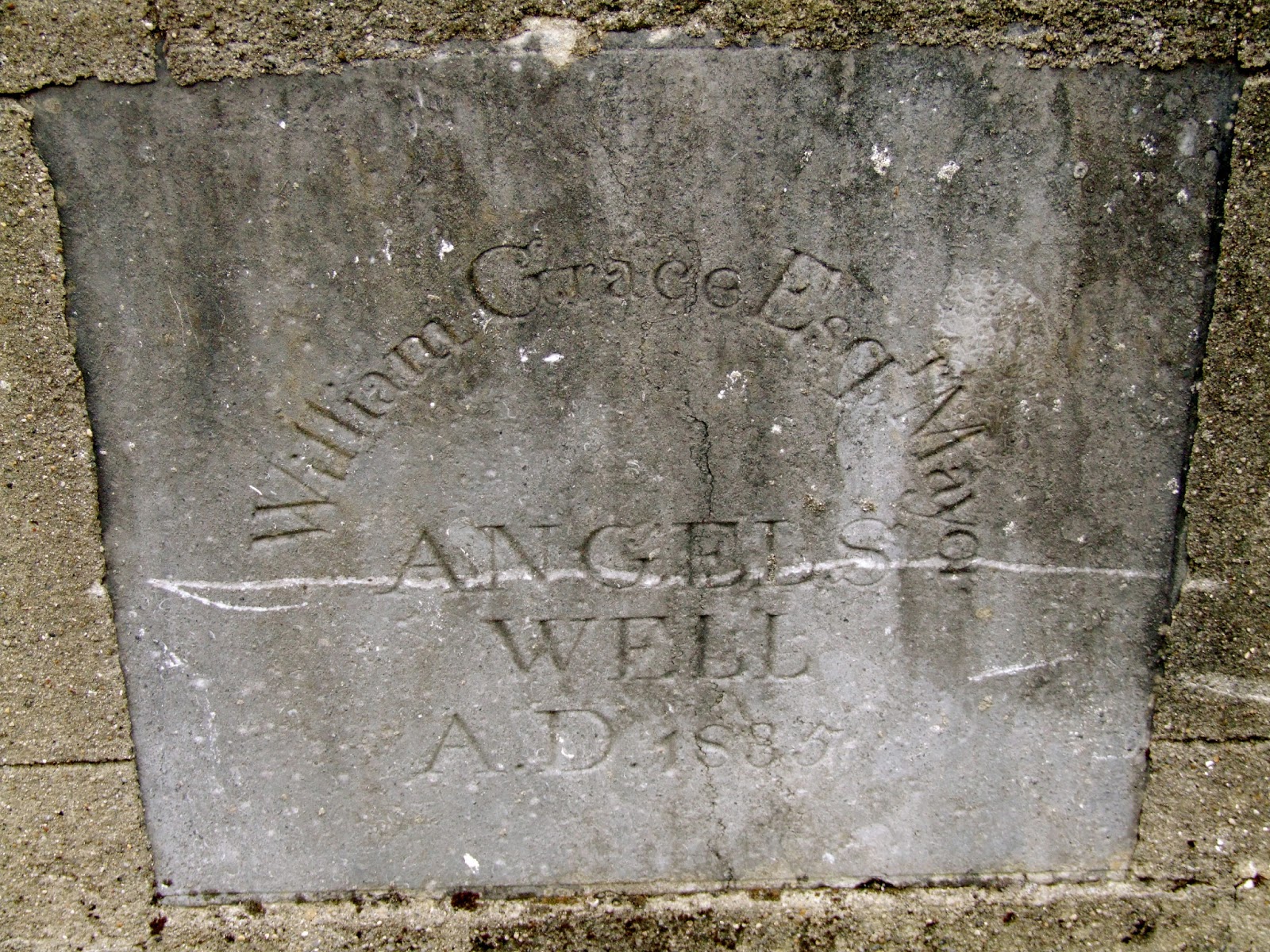
The dedication stone above the well


The original foundation had no water source and the monks had to travel up the hill out of the confines of the abbey to fetch water from Saint Canice’s well (called ‘Kenny’s well’ by locals). When an outbreak of bubonic plague hit the city of Kilkenny the monks knew that travelling backwards and forwards to the well each day was becoming a dangerous activity as many of the sick and infected were now permanently camped out around the holy well in hope of a cure. To avoid the spread of infection to the members of the abbey the Dominicans requested that a small channel be built from Saint Canice’s well to a deep trough in the grounds of the abbey to allow the monks to draw water without having to leave the abbey. The Bishop was said to have been greatly concerned at the effect this might have upon the level of water in Saint Canice’s well and did not want all the water to be drained to the abbey, especially in light of the many sick and infected who were gathering at the well to pray for a cure. Legend has it he finally relented to the request of the Dominicans by telling them they could build their channel so long as it was no larger than the circumference of his ring. The channel was built and the well housing made over the trough. Today the water from Saint Canice’s well still flows through this very narrow channel without any detrimental effect upon Saint Canice’s well up the hill. Over time popular devotion around the redirected well grew and it began to be treated as a separate holy well and even began to be called Angel’s Well; although nobody is quite sure why it was given this name. William Grace, the mayor of Kilkenny, erected a new well housing around it in 1885.

Angel's well


It’s not easy to get in close to this well as the garden area is often locked, although it is clearly taken care of very well. The well on the other hand is slightly neglected, with much silt and a few bits of rubbish. It’s a curious thing for a well to gather its own forgotten history, but the mystery of why it is called Angel’s Well will no doubt remain lost in the mists of history, but even if you can’t get in to visit this well you can always go up the hill to the source of the water in it!

Grant O Lord Jesus Christ, that I may persevere in good purposes, and in thy holy service, to my death; and that I may this day perfectly begin, for all I have hitherto done is nothing.
 Amen.
A prayer from the Dublin Dominican Manual, 1913.

 Kilkenny city


How to find it:
The Black Abbey is now clearly signposted and sits on the corner of Abbey Street. The small railed garden is opposite and the well is in the top corner by the street.


Tuesday, January 1, 2013

Ladywell, Durrow, County Laois.

The holy well


Ladywell is situated outside of the town of Durrow and about 90 kilometres into County Kilkenny, falling into the diocese of Ossory. At the site there is both a holy well and a shrine to the Blessed Virgin Mary. It is listed, along with another number of wells in a booklet produced by Canon Carrigan, who was considered to be a diocesan historian. When I visited major works were underway and it was impossible to get close to the well.

The Shrine to the Virgin

In more recent years, Ladywell has undergone very significant change with the fencing off of a field for use as a car park, the erection of a fairly significant modern concrete shrine to the Virgin and the transformation of a shed into an open air chapel of sorts, complete with pews and chairs to accommodate around two hundred or so people. The well itself was undergoing some work when I visited, surrounded by caging and set within broken quarry stone. I can only hope that archaeologists were consulted before this work was carried out, but I somehow doubt it.

The large seating area at the well

The parish priests of the area have long had concerns about the practices at this particular well and decided throughout the history of the well to try and remove what they considered to be ‘pagan’ or ‘semi-pagan’ practices. The praying of ‘rounds’ has been discouraged even to this day and the trees have been removed to stop the tying of rags. Making ‘rounds’ has always been an early Christian practice; firstly, to be done in such a way as to greet the rising sun, secondly as a way of invoking the Trinity (done three times), and thirdly as a symbolic act for those who could not afford to make the pilgrimage to Jerusalem, or in times when it was considered to dangerous to do so. The practice reached its zenith in the medieval period with the development of labyrinths, some of which still survive in medieval cathedrals today traced out in tiles on the floor. There are no tokens left at the well either. Early traditions included bringing a stone, small or large, which you took with you for the entire pilgrimage to the well and sometimes they were deposited there. It’s hard to know exactly why this practice was done, but it may have a parallel in a practice done on Atonement Day in Judaism, linked to the casting off of sin. Tying rags or ‘clouties’ is a relatively modern practice associated with prayers for healing. In the past, pilgrims carried a strip of white linen or cotton (which presumable became quite dirty along the way) and tied it to the tree as a symbol of forgiveness and the washing away of sin. The practice in this ‘pure form’ was still going on in County Down at holy wells into the early 1980’s and many white linen strips could be seen at wells. But even then, there were signs of it being replaced by the more modern practice. The idea of hanging your sins on the tree has of course very strong Christian parallels to Christ on the cross. Trees were also important in pre-Christian Celtic times and the presence of trees at holy wells is something of a pagan hangover with some evidence that the early Irish saints were happy to accommodate or tolerate their veneration, but exactly why certain trees were venerated in some places is unclear and it isn’t clear either as to why the early Irish saints accommodated this.

Ongoing works at the well

Ladywell during much of the nineteenth century was a somewhat obscure well, rarely visited. It lay in the centre of a field, accessed by a narrow grassy path where a large and ancient hawthorn bent over the spring well. Today, the well is clearly attracting much attention and obviously accommodates significant gatherings. In ancient times Ladywell was one of the stations on the Rosconnell pilgrimage. Little is now known of this ancient pilgrimage route or what other wells were included. The first mention comes in 1731 in a report from the Church of Ireland Bishop Tennyson of Ossory who laments that the building of booths in deep trenches all around the walls of his church at the time of the pattern and he expresses some concern that it might have a negative effect on the structure. By 1870 the traditions at Ladywell had begun to fade away. The Reverend Patrick Neary, curate of Ballyouskill and member of the Ossory Archaeological Society remarks that he found someone who remembered tents being erected at the well during the Feast of the Assumption, so we can assume that because he records a remembrance the tradition had essentially stopped.

Scapula's left at the shrine

The diocese of Ossory was somewhat strict about practices at holy wells (dare I say it, a tradition they seem keen to keep up today to a degree) and in 1810 began to stamp out any practices in the diocese. The effect of this was to remove all but the most significant Irish saints from the church’s calendar, although today things are beginning to change a little. Another result was the neglect of holy wells and pilgrimage sites and even the remembrance of local saints, with much material being lost, deliberately destroyed and some holy wells even being filled in. At one point the diocese even announced a ban from the pulpit on any attempts to make pilgrimages to holy wells. Oddly, this was the trigger for the revival of interest in Ladywell. A crowd of four hundred people made a pilgrimage to the holy well in defiance of the diocesan order. The crowd stayed at the well for some time and a police report filed on 15th August 1881 records that the gathering was orderly and passed off peacefully. In 1900 Tom Delaney from Ballinakill erected a stone cross at the well. Interest in the well continued until 1929 when a committee was formed to look after the well and they erected a collection box to garner funds for a statue of the Virgin. A statue was duly purchased and a small altar was carved by James Coady of Ballinakill which stood in the open air until a shrine was made to enclose it in 1942.

It wasn’t until the 15th August 1940 that the Catholic church finally recognised the site as being of religious importance to people, and an understanding priest (Fr William Kerwick) said the first public rosary at the shrine. It was Fr Kerwick who mobilised the committee to apply for the plot of land around the well and this application was successful in 1948 with rights granted for public right of way. From this time on the services and prayers at the shrine and well have continued to develop and grow and the well has undergone subsequent changes right up to the present day.

 The statue of the Virgin

When you arrive on the site the first thing you see is the large barn with chairs and pews that provides shelter for the services and the reciting of the rosary. The statue in the shrine dates from 1954 and was purchased to commemorate the Marian year. The first mass at the well was celebrated by Bishop Peter Birch of Ossory on 15th August 1980, but the practice of making ‘rounds’ was publicly discouraged. By the year 2000, the clergy of the local churches were slightly less concerned about trees and bushes near the well and an oak tree was planted – although not anywhere near the well it must be said! In 2001 a tradition began of marking a novena from 31st August until 8th September with the public saying of the rosary, benediction and a guest speaker each evening.

I don’t know if water is drawn from the well anymore, but when I visited a set of steps was being built down to it. It must have been quite deep and maybe even dangerous in days gone by, but now it is clearly visible and will be easily accessed when the works are completed. It appears to have a significant lime content as the water has a milky quality, but this may have been from recent works. It is not entirely a peaceful place, but it has become so bound up with the events that take place on 15th August that it is somewhat hard to get a sense of it when you visit outside these times. It is somewhat barren in terms of its surrounding countryside and there is certainly a sense of being exposed to the elements. Many holy wells are in picturesque locations and often sheltered in valleys and hidden by trees, but this well is exposed to the wilds of the Irish weather and one can imagine that in times past this well was probably more about a pilgrimage of penance than a resort for solace of the soul.

Ladywell today

We magnify thee, O Mother of the True Light,
And we glorify thee, O virgin saint, birth-giver of God,
For thou hast borne unto us the Saviour of the world;
He came and saved our souls.
Coptic Orthodox intercession to the Virgin.

How to find it:
On the road out of Durrow towards the town land of Ballinakill the holy well is clearly signposted down a narrow road to the right. Towards the end of this road a large tree sits in the centre of the road and to the right is a grassy area surrounded by tarmac and the well is situated at the far end of this site.

The original stone cross?