Showing posts with label cromwell. Show all posts

Tuesday, February 19, 2013

Angel’s Well, Black Abbey, Kilkenny.

The Black Abbey, Kilkenny


Sometimes you come across a holy well that has either little or no information about it at all except in the memory of those who live nearby. Angel’s well is one such example, but after a long search and quite a few questions, in early July of 2012 I finally found an answer from a quiet monk in the Black Abbey in Kilkenny city.

The Abbey garden


The Black Abbey is a curious place with a name that conjures mystery and a certain solidity. It’s hidden behind houses, down a little back road and surrounded by the typical Medieval meandering and narrow streets that one associates with Medieval towns and cities like Kilkenny. It was originally built through the generosity of William Marshall, Earl of Pembroke, in 1225. It’s original structure was of a simple and plain stone abbey in a standard abbey shape, but a tower was added in 1507. The interior aspect has changed, with the tower rising above what is now the sanctuary which would originally have been the long choir. The south aisle (which runs adjacent to the nave) is the entrance and the now shortened choir is now the sanctuary. It’s an odd orientation that doesn’t quite work and sadly it’s interior feels a little out of sorts and somewhat patchy, with furnishings that are modern and simple and yet for some reason still don’t quite fit. It’s not at all helped by the sanctuary sporting a modern stained glass window which I didn’t find particular beautiful and is far too dominant a force in the building. The Black Abbey has clearly suffered much, not least during the dissolution of the monasteries during the reign of Henry VIII when the abbey was closed for period and used as a court house. In 1603 however, the citizens of Kilkenny staged a minor coup, and seized the abbey to return it to the Dominican Order. The future looked bright, but then Oliver Cromwell came along with his forces and did what he was best at in Ireland -  he sacked it and tore down the nave. The rest of the church suffered in this sacking too and the abbey was finally completely restored (minus its original sanctuary) in 1860.

The carving of the Holy Trinity


There are some reasonable examples of Victorian stained glass in the abbey still, with a large impressive Rosary Window  (supposedly the largest stained glass window in Ireland) adorning what was the south transept (the north transept seems to have disappeared without trace; if there ever was one). Beside this sits an oddly un-orthodox carving of the Holy Trinity (the dedication of the abbey) in the sense that it has a figural depiction of God the Father complete with a beard in the style of an Irish chieftain! Although the carving is dated to 1264 at its base, various experts in the field have dated the carving to the later fourteenth century. Whatever the case it is remarkably well preserved for it’s age.

A medieval narrow street in Kilkenny


The outside of the Black Abbey is directly on a road, but in the immediate vicinity of the abbey walls you can see ten stone coffins lined up dating from the thirteenth century.  Across the street -  where part of the long choir and the sanctuary would have been - is a small railed off garden with the holy well in the top right hand corner. The Dominican Order settled initially in Dublin with Kilkenny being the third site of settlement. The abbey was so named due to their style of habit, with a black cloak or cappa worn over their cowls. Founded by Saint Dominic, they were established as an order of preachers, but quickly acquired the nickname of Dominicans; a play on words for Domini Canes, or ‘God’s dogs’ whose primary function was to rid the Christian west of the gnostic sects. As an order it has struggled to achieve it’s goals, having very limited success in combating the gnostic Albigensian heresies and consistently doing battle with paganism until a new battle line was drawn with humanism during the Renaissance. The order was most effective during the eighteenth and nineteenth centuries in that period of western expansion and colonialism when the Domnicans became galvanised in their teaching on human rights when they witnessed the brutal treatment dished out by colonialists to native peoples. Despite preaching and advocating a Gospel of equality for all people – a message deeply unpopular and resented by many at the time – the order experienced a revival by the end of the nineteenth century, which was probably fortuitous in the restoration of the Black Abbey in Kilkenny.
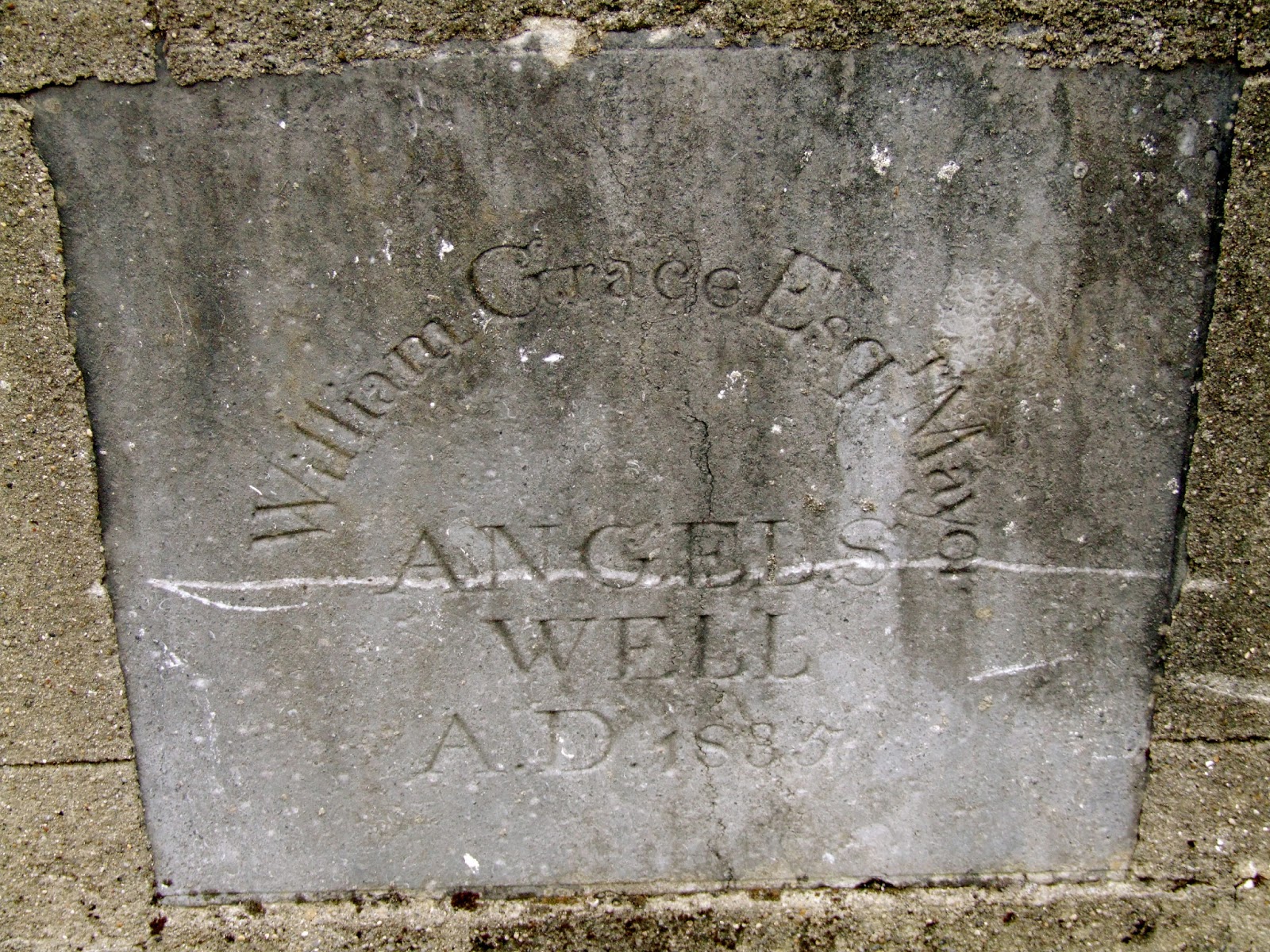
The dedication stone above the well


The original foundation had no water source and the monks had to travel up the hill out of the confines of the abbey to fetch water from Saint Canice’s well (called ‘Kenny’s well’ by locals). When an outbreak of bubonic plague hit the city of Kilkenny the monks knew that travelling backwards and forwards to the well each day was becoming a dangerous activity as many of the sick and infected were now permanently camped out around the holy well in hope of a cure. To avoid the spread of infection to the members of the abbey the Dominicans requested that a small channel be built from Saint Canice’s well to a deep trough in the grounds of the abbey to allow the monks to draw water without having to leave the abbey. The Bishop was said to have been greatly concerned at the effect this might have upon the level of water in Saint Canice’s well and did not want all the water to be drained to the abbey, especially in light of the many sick and infected who were gathering at the well to pray for a cure. Legend has it he finally relented to the request of the Dominicans by telling them they could build their channel so long as it was no larger than the circumference of his ring. The channel was built and the well housing made over the trough. Today the water from Saint Canice’s well still flows through this very narrow channel without any detrimental effect upon Saint Canice’s well up the hill. Over time popular devotion around the redirected well grew and it began to be treated as a separate holy well and even began to be called Angel’s Well; although nobody is quite sure why it was given this name. William Grace, the mayor of Kilkenny, erected a new well housing around it in 1885.

Angel's well


It’s not easy to get in close to this well as the garden area is often locked, although it is clearly taken care of very well. The well on the other hand is slightly neglected, with much silt and a few bits of rubbish. It’s a curious thing for a well to gather its own forgotten history, but the mystery of why it is called Angel’s Well will no doubt remain lost in the mists of history, but even if you can’t get in to visit this well you can always go up the hill to the source of the water in it!

Grant O Lord Jesus Christ, that I may persevere in good purposes, and in thy holy service, to my death; and that I may this day perfectly begin, for all I have hitherto done is nothing.
 Amen.
A prayer from the Dublin Dominican Manual, 1913.

 Kilkenny city


How to find it:
The Black Abbey is now clearly signposted and sits on the corner of Abbey Street. The small railed garden is opposite and the well is in the top corner by the street.


Tuesday, July 24, 2012

Saint Fiacre’s Well, Kilkenny.

The stone gate to the old church


Saint Fiacre is a man shrouded in myth and legend, yet the very fact of the huge measure of devotion to him down through the centuries speaks clearly of his well-won reputation as a holy man. We know with some certainty a few facts of his life from the ‘Matryology of Donegal’, but there are many stories connected with him which are often tales only told to try and explain some of the seeming contradictions of his life. During his life Fiacre attracted many followers and those who would either try to emulate him or who felt that living close to him would inspire and encourage them also in their pilgrimage through life. One such example was Saint John of Valois, whose devotion to Fiacre led him to build a great hermitage close to the dwelling of the Saint at Breuil in France. Saint Vincent de Paul, the Apostle of France, made a regular pilgrimage to the shrine of Saint Fiacre. Devotion to the Saint continues to this day in France. Archaeological finds attest to his significance for French pilgrims who at one time attached small metalwork badges of the shrine of Saint Fiacre to their clothes. Fiacre is also depicted in many illuminated Breviary’s, most often with a spade in place of a staff.

Old Saint Fiacre's Church

In Ireland Fiacre began his life as a seventh century hermit or anchorite and is also said to have served as a priest for some time. His Irish lineage was impressive, stemming as it did from Conn, King of Ireland from 523-577. Fiacre is believed to have been born around 590. Even in early youth he was noted for his generosity towards the poor and less fortunate and later he was to become famous for his wisdom and judgement in all matters and for his skill in working with the land - hence his association as the patron saint of gardeners. Although he served the people dutifully, his true desire was for solitude and prayer and he retired to a small patch of sheltered woodland on the banks of the river Nore where there was a fertile plain and a deep well with fresh, safe water known today as Kilfera (Cill-Fiacre). Here he could live out his days in peace…or so he thought.

 The fertile banks by the river

Over time the people learned of his small hideaway and they began to pester the Saint, looking for advice and his blessing. Seeking solace in Ireland was going to prove impossible and so the saint made an appeal to Bishop Faro in France for a small portion of land for him to live on. The Bishop granted this request and Fiacre moved to the area, close to the town Saint-Fiacre in Saint-et-Marne as it is today. Oddly enough, within a relatively short time Fiacre seems to abandon his anchorite calling and instead he begins to adapt the land given him by Bishop Faro for passing pilgrims and seekers. On the land he creates an oratory for prayer, dedicated to the Blessed Virgin Mary, a garden for reflection and quiet and a hospice where passing pilgrims could stay. There are various legends that attempt to explain why Fiacre abandons his desire for solitude, but none are very satisfactory.

The crucifix and stone altar

Over time the hospice for pilgrims attracted many thousands of people each year who were seeking a place of prayer and intercession and peace. Fiacre encouraged them to live meager and self-sufficient lifestyles and taught skills of gardening and land management. In 670 Saint Fiacre died at the site in France and his remains were moved to Meaux. In Ireland Saint Fiacre is best known for his interventions during the Tithe War when many farming families were left with no means of income and no food. Fiacre is said to have brokered a deal on behalf of the locals which resulted in the return of their cattle. One story tells of this in typical Irish fashion: the people of the area gather at the site of Saint Fiacre’s well and implore him to help them after their cattle have been raided. Before the cattle can even make it as far as Ballytiglea bridge near Borris, Fiacre prays for their safe return and a swarm of bees appear and drive back the cattle to the area at such speed that the cattle raiders are unable to stop them. A song regarding this miracle is still sung in the area to this day (St Fiacre and the Bees, written by J.Norris). Despite the typical ‘tongue in cheek’ story, there may yet be some truth in it. Nobody knows exactly what deal Fiacre brokered that was satisfactory during the Tithe War, but maybe it involved honey or bees from a hive?

The holy well

Saint Fiacre’s well is today at the base of a large set of semi-circular steps that has a small stone altar and large crucifix at the top. It looks over a large flat plain and is surrounded by a wooden fence. On the day I visited the local people hadn’t started clearing the area in preparation for the pattern so it was a little overgrown after a long wet summer. The well water was also full of a slimy weed that made it look fairly unappealing. Nevertheless, I could see the ancient stone structure of the well and I could see that it was also extremely deep.  The entire setting of the well and shrine is very beautiful. It is amazingly difficult to find, hidden in a dip and behind a bank of trees.

The deep well with stone surround

The pattern in honour of Saint Fiacre lasts rather a long time; from 15th August until 8th September. On 15th August, pilgrims gather on the banks of the River Nore and walk to Saint Fiacre’s ‘bed’. The present construction around the site with the steps, altar and crucifix was completed in 1930/31. The pattern began to be less and less observed until it had almost completely died out in the 1950’s and 60’s, but a few loyal local people kept the faith and devotion to the local saint and today the pattern has revived again. In 1992 a new parish church was opened in the area by Bishop Forristal and the dedication was to Saint Fiacre. There is a church ruin near to the site of the Saint’s retreat on the banks of the river which also bore his name. Today it appears to be a ruin that may have dated to the early Georgian period, but it is difficult to be sure. It replaces an old Medieval site and the graveyard houses a stump of stone said to have been a tall stone carving of Saint Fiacre that was destroyed by Cromwell’s men. I searched for the stump, but the graveyard was badly overgrown and there were many stone stumps!

A stone arch at the church

The well water is holy by association to the saint. There are no records of anyone being baptized in it - although it is surely deep enough – and no accounts of it being blessed by the saint or having anyone experience healing of any kind. Local people had a curious tradition of bringing small bottles of the water from the well onto ships as a kind of talisman for protection. In the past, those who left Ireland to make the journey into Europe or to the America’s often travelled with a bottle of water from a holy well near their home, possibly as a reminder of where they had come from. There is however a story of Captain James Casey who was a native of Graignamangh, who on a boat journey home in 1775 hit a terrible storm and began to fear for his life and that of his crew. In a panic he invoked the saints help and the storm subsided enough to allow them a safe journey home. As an act of thanksgiving he presented a large processional cross to the church in Graignamanagh which you can see to this day, and this tale may explain why some travelling by sea took a small bottle of water with them from Saint Fiacre’s well. 

 The view from the well over the plain

Hear us O Lord as we visit this retreat of your confessor Saint Fiacre, that inspired by his work and witness we may express a hospitality and peace that befits our faith; through your Son Jesus Christ our Lord, who with you and the Holy Spirit, lives and reigns, one God, now and for ever. 
Amen.

A cross in the graveyard

How to find it:
From Kilkenny city take the N77 and from this road take a right turn onto a narrow boreen which goes in a loop around an old estate. In sight of the church ruins, cross two fields and down into the small hidden dip where the well is.