Friday, March 9, 2012

Our Lady’s Island, County Wexford

The statue at the Shrine of Our Lady looking out over the lake


This is a place that draws one again and again. It is beautiful, but not stunningly so. It is quiet, but not absolute solitude. It is peaceful; peaceful almost beyond compare at times but you never feel totally away from everything or everyone. I must begin by stating that I have never been to this place during the large and important pattern that takes place here at almost every Marian feast throughout the year. I have seen the preparations for it and watched as they practiced for concerts and shows as part of the festivities, but for some reason I felt it would spoil the magic of this place for me and so I haven’t ventured near it at these times.

 A boat rests on the shore

Our Lady’s Island is in County Wexford. It has been a place of pilgrimage for a very long time.  It was one of the pilgrimage sites that was permitted to flourish under the time of Pope Benedict from 1740 to 1753. Apart from Lough Derg, all other pilgrimage sites were suppressed, patterns were discouraged and many Irish saints began to become neglected and forgotten. Lough Derg was always the more popular site though and there was never actually a tradition of people staying on Our Lady’s Island in the way that they do at Lough Derg, so numbers naturally began to drop. In recent times though, this place has experienced something of a revival. In 1978 during the pilgrimage in August, over twenty thousand people turned up. Since then the pattern days and festival outdoor Eucharist’s have attracted thousands and many thousands visit the island year after year.
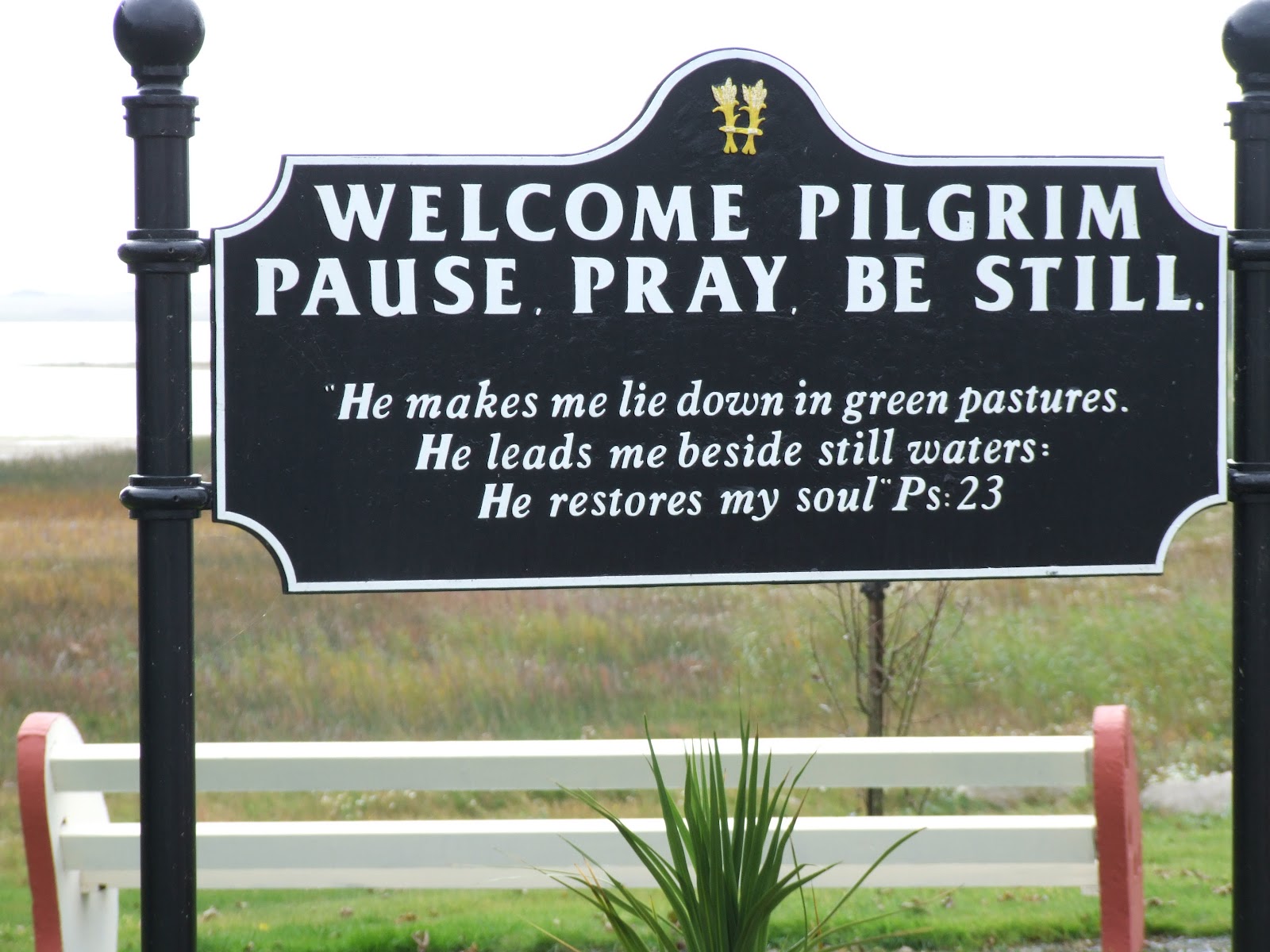
The sign at the start of the island walk

Our Lady’s island is a small island of around thirty or so acres attached to land by a man-made causeway.  The lake that the island sits in is just over two miles in length and one mile across. The area has associations with Saint Ibar, Saint Abban and Saint Vaugh. Saint Ibar established his monastery at Beg Erin island on the northern side of Wexford harbour, shortly before the arrival of Saint Patrick. The monastery had a somewhat hard time, eventually being attacked and destroyed by the Vikings in the ninth century. The ruins of a nearby church carries his name as its dedication, but nothing of the original foundation now survives.

The ruined church of Saint Abban

Quite a lot is known of Saint Abban because three accounts of his life survive; two latin versions are to be found in the Codex Dublinensis and the Codex Salmanticensis and an Irish version in a manuscript copied by a Micheál Ó Cléirigh (one of the scribes of the Annals of the Four Masters). Saint Ibar was said to be the maternal uncle of Saint Abban, who was of an illustrious Irish family line. His education consisted in being taught by other famous saints, but as to exactly who they were is up for debate, as those listed in the accounts of his lives differ on the detail and bring a question to the dates of the Saints birth and death. The saintly quality of Saint Abban was said to have been obvious even from the early time of his travels to Rome with his uncle and the tales of his life compare him to Christ in his command over the sea and over rivers. It’s possible that Saint Abban travelled a lot throughout his life as he is associated with quite a number of places throughout Ireland and Saint Gobnait is said to have been his sister and his remains are said to have been buried at her foundation. Saint Abban has two feast days, 16th March and 27th October , but he is thought to have been responsible for the foundation of the monastery on Our Lady’s Island.

 Swans on the lake

Saint Vaugh also has an association with the area, but all memory of the saint is now lost. Modern tales tell of a stone that managed to float and bring the body of the dead Saint Vaugh back to the church founded in their name in 585AD.  There is a slight problem though: the church at Carnsore Point is also associated with a Saint Vogue (aka Saint Veoc). The reality is that nobody is terribly sure if Saint Vogue is the same person as Saint Vaugh and to be honest it seems somewhat unlikely that a saint from Brittany would have a link to a remote part of Carnsore Point in County Wexford.  Saint Vogue or Saint Veoc on the other hand is listed in sanctorales and he is known for his great compassion, although tales appear to have been lost. The church at Carnsore Point is of very old foundation with a medieval structure built on top. It is very small and likely to be a shrine church for the burial of the body of the saint.  At this church there is supposed to be a holy well and also a peculiar carved cross in a Chinese style sitting on a lotus. I haven’t seen it myself, but it has made me curious enough to search for it twice with no success!

The roadside sign to the well

Many people think that the pilgrimage route begins at the car park at the top end of the island where the causeway is; but they are wrong! The pilgrimage begins a little way from the island itself. If you are travelling by car, the best thing to do is to park at the car park at the head of the island. From here, walk up the slight hill (with the lake to your right and the church to your left) until you come to a T-junction and at this point, turn right.Very close to this point is an old mass rock, now decorated with a shrine. When the mass was outlawed in Ireland, faithful Roman Catholics met in secret at this rock for the celebration of the Eucharist from 1660 to 1760. A silver chalice is kept in the Church of the Assumption that has the inscription ‘Not to be taken from the island.1731’ and was likely used at the mass rock. It is down this road that you will see a sign to the well that requires you to clamber over two walls and two fields.

The well enclosure

The holy well is now on a golf course and it overlooks the parish of the Assumption and the island. It is a small and shallow well with an unassuming statue of Our Lady watching over the waters. The well is surrounded by white washed walls on three sides and has a small gate at its entrance. Some people have left prayer requests tucked in behind the Virgin.  A small ditch carries the well water away towards an ancient standing stone. If you arrive at the right time you can say the angelus here at the start of your journey (the start of Mary’s journey too in a sense) while the bells play in the distance.

The holy well

Eternal Spirit of God breath on us that we may know quiet and contented minds and lay all our burdens on Christ; take from us all anxiety and disquiet and draw our hearts to the Father by the power of your love; lead us to the peace that passes all understanding, to the silence and the stillness that reveals you among us.
Amen.


From the well (which is said to heal all manner of ailments), head back to the church and car park passing the farmland as you go. In this farmland a papal bulla was found by the Druhan family in 1941, while they were ploughing their fields. It was once attached to a document given by Pope Martin V (1417-1431) which granted an indulgence to anyone who frequented Our Lady’s Island. In 1607 Pope Paul V also granted indulgences for those who would visit the island during the feast of the Birth of Our Lady or the Assumption. A further grant of indulgences for visitors to the island was given in 1904 by Pope Pius X and the Papal Letter is preserved in the Parochial House.

Candles

As you approach the island there is a large sign inviting you to pause, be still and pray. It might seem like a curious suggestion to rest when you will be doing a lot of walking, but the island has a habit of drawing you into its atmosphere of going slowly, reflecting and pausing for silent prayer. The remains of a large tower lean rather precariously to one side, once erected to protect the island and possibly related to the protection of land under the care of Strongbow. A statue of the Blessed Virgin Mary overlooks the scene as you move past the tower towards an area with black covered trays where you can light a candle and say a prayer before you begin to walk the island.

 An invitation to prayer

In behind this area is the remains of the foundation of Saint Abban. After Saint Abban’s foundation ceased the mantle was taken on by the Augustinians who had a long association with pilgrimage sites, but particularly with Our Lady’s Island and with Lough Derg. They remained on the site until Cromwell’s forces landed at Wexford in 1649. They burned the castle, pulled down the church, stole the communion vessels and murdered the monks. The same happened at Saint Ibar’s church. Legend tells of a young boy who was praying in Saint Ibar’s church at the time, realized what was happening and snatched the crucifix from above the tabernacle. Running from Cromwell’s men, he made a dash for the island but realized that the men had followed him and he was trapped. In desperation, still holding the crucifix, he started to enter the lake, but was shot and killed. This was thought to be a tall tale until in 1887 a boy by the name of Cogley who was fishing for eels off the end of Our Lady’s Island thought he saw an eel in the muddy shallows. Groping in the mud he felt something hard, and pulling it up from the water realized it was a crucifix. He brought it to Fr Thomas Roche, the then parish priest who had it repaired and restored in Dublin. The crucifix can still be seen today in the Church of the Assumption.

The start of the island walk

From here the pilgrim goes in between two large stones to begin the walk around the island. Traditionally pilgrims were expected to walk around the perimeter of the island in bare feet and in the water. Not only is it cold, but the stones are sharp in places and the mud, thick and deep in others. Today, most people walk on the grassy pathways. As an island pilgrimage it preserves the ancient Irish Christian tradition of doing penance. Sir Robert Southwell, secretary of the State for Ireland in the eighteenth century, recorded some observations at the time regarding the practice of the barefoot and wet-footed penitential pilgrim;
‘If any Lady, through indisposition, be loath to wett her feete, there are omen allowed to doe it for them, they being present and paying half-a-crown for a fee. And this penance is effectual enuffe.’

The Shrine of Our Lady

Along the path there are various spots to stop for a little while and pray, or to contemplate or simply enjoy the peace. On the lake the swans tend to gather in this area and on the far hills a group of wind turbines quietly gather their energy.

A place to pause and pray

As you approach the bottom end of the island you come to the most important area after the holy well. This is the Shrine of Lady’s Island, built in 1900. Originally it was surrounded by a low wall and enclosed with a small gate. The statue of Our Lady sat on top of an altar type structure, but today it has been restructured, and I don’t think its for the better. Now it looks merely like a whitewashed garden ornament. It has a place to sit, but it doesn’t really feel like a shrine anymore. Originally it was used as a point of procession, and at this point prayers and services were held before the procession back to the church.

The well on the island

From the shrine pilgrims would make their way back to the church. On the way there you can stop and light another candle and pause for prayer and also pay a visit to a more modern ‘holy well’. This ‘holy well’ is very modern and was most certainly not around in the early 1900’s. It is most likely formed from the run-off from the farmers fields on the flat top above. Signs around the well warn people not to risk drinking from it. It’s a curious well, with no connection to any of the saints associated with the area and so, unlike Our Lady’s Well, is unlikely to have been a baptismal site or a pilgrims starting point for pilgrimage or entry into the church or community. Oddly enough the 2010 state conservation plan identifies this as being the holy well and totally ignores Our Lady’s well as if it wasn’t there! Ultimately though, this well - like some others – is made ‘holy’ by tradition and through the many prayers of the faithful in this place.

The small wooded area

Not far on up from this point is a small wooded area with a seat and a large wooden cross. Even in winter this place is sheltered and amazingly peaceful. It marks a suitable end to a brisk, exposed walk where one can reflect and pray with ease.

Interior of the Church of the Assumption

From here it’s a short walk to the church of the Assumption. Originally the church carried a more simple dedication as the church of Saint Mary. I’m not sure when its dedication changed, but it may have taken place around the time of the addition of a statue of Christ the King to the front of the church, which I am told was around the 1930’s. Inside the church is a little gem. It’s a Gothic revival building designed by Pugin and Ashlin. Some of the original features have been preserved very well and the lighting globes down the church are the best preserved I think I have ever seen.


May our Blessed Lady pray for us. May Saint Ibar and Saint Abban pray for us. May all the saints of God pray for us. May the holy angels befriend us and watch around us to protect us, and may the Lord bless us this day and always.
Amen.

The paths on the island's edge

If you wish to join others for a pilgrimage to Our Lady’s Island you can check out all the details on their website: www.ourladysisland.ie ,which has lots of information and even some suggested prayers for personal use when visiting the area and it will tell you how to find it.

Fields of gold

How to find it:
From Wexford follow the signs out the N25 for Rosslare until you reach Tagoat. Almost immediately after leaving Tagoat follow the signs for Our Lady’s Island on the right.


Thursday, February 16, 2012

Cooey's Wells, Tara Bay (near Portaferry), County Down

The sign at the entrance


Down a beautiful stretch of Strangford Lough, not far beyond Portaferry is the place where three wells lie in a ditch below a ruined church, sheltered slightly from the bitter sea breeze by a saintly road now sunk deep in bog. These are the Cooey wells that take their name from Saint Cooey.

The path down to the site

Cooey is his nickname. The saint’s real name is Saint Cu’Mhaighe and he is unfortunately only recorded in tradition. He appears in no obits and in no other accounts of the lives of saints, although legend has it that he was to become abbot of Movilla before his death. His name does appear however in other forms, creating place-names in the surrounding area. Even tradition tells us very little of who Saint Cooey was or what he did, or even where he was from. All we know is that he was incredibly disciplined in his practice of penitence which greatly impressed the local population - so much so that they decided to follow his religious faith and practice and shortly established the parish of Witter by his wells and near the stones that he is said to have frequented to do penance. The church is recorded as being established by the seventh century, but now only a few broken stones remain. You can see the stones, partially encased in a wooden box on a modern altar with a covered roof. All around are little headstones of buried saints and early Christians.

 The modern altar

The modern structure of an altar and a wooden case for the stones with a roof was the result of efforts made by Fr David Morgan in 1976. By the 1970’s Cooey’s well and site had almost been forgotten. It was neglected by the tourist board and left to become overgrown and inaccessible. In 1976 Fr Morgan, his parishioners and a local farmer set to work to make access to the wells and the site possible again. They built a road up to a car parking area and paths down to the old church site. An altar was made and a roof placed over it, marking the site of the original church, and the three wells were fully restored. In 1978 over a thousand people from the area turned out to make a pilgrimage to Cooey wells once again. The tradition of making a pilgrimage to Cooey wells on the Sunday closest to Saint Peter and Saint Paul still continues today. This is the poem of a local man, William McCarthy, who writes of his gratitude at the completion of the work on the site in the 1970’s:

Stones of the original foundation

The Road To Cooey's Wells

There's a place that haunts my memory, that always seems to stay,
Since I first sought St.Cooey's Wells, one holy Sabbath day,
I trudged the rugged pathway, through woodland hills and dells,
To seek a cure from those waters pure, that flows from Cooey's Wells.

As I try to pace this awful place, all sinking in decay,
A lone skylark accompanied me that lovely summers day,
Where no brain of man had thought to plan, no human hands had made it,
Like the endless sea t'was wild and free, as Mother Nature made it.

I crossed the rusty bogland, and tramped through field and fallow,
With many an unseen pitfall set, through water deep and shallow,
Now twenty years have long since gone, since first I made my way,
My footseps are unsteady now, my hair is turning grey.

Since I first sought this place divine, and crossed the hills and dells,
And trudged that rugged pathway, to St Cooey's Holy Wells,
Today I've wandered back again, as I have often done before,
And again I stand on this barren land by the lonely windswept shore.

This place still haunts my memory, since first I made my way,
My footsteps are more feeble now, as here I stand today,
No rugged footpath have I crossed, nor climbed the hills and dells,
For the new roadway I've trod to reach the Holy Wells.

Now I write this lay in tribute, this message to convey,
To those gallant men who toiled so hard, this new roadway to lay,
So let us sing their praises high, they toiled but not to gain,
And I believe what they achieved a symbol shall remain.

To the old and young, and everyone, that helped in any way,
We cannot thank them as we should, but we for them can pray,
At last not least our Parish Priests no effort did they spare,
In their devoted way they helped to lay that new made roadway there.

Now I thank the Lord for every word he gifted me to pen,
Who gave light this day to write to praise those gentlemen,
When memories old our minds unfold throughout the coming years,
Remember them of whom I pen, those gallant Volunteers.

The first well

As you come down the path to the new altar, follow on round to the three wells. They are slightly over tended, but nicely maintained nonetheless. The wells are labeled in terms of what the visiting penitent should do. Following the path around further you will find a large reed bed that leads out onto salt marshes by the sea along the saint’s path towards a stone, said to be Saint Cooey’s penitential stone.  It’s basically a large flat stone with some white pebbles embedded in it which are said to represent the points where the saint placed his knees and his hands to pray.

The second well

It is a beautiful place, and a peaceful place too. Despite the restorers like of concrete, I have to say I’m glad they made the effort, for without them this place would have surely been lost. I can’t say it’s a place I would want to visit on the large local pilgrimage day though. The saint’s life seems to suggest that a visit close to lent would be more suited and the area is certainly suited to a penitential feel, especially in winter.

The third well

O God our Creator, look down on Thy sinful and unworthy servants, and when we are called to venerate Thy holy Name, deprive us not of the hope of Thy mercy. Grant unto us, O Lord, all that be needful for salvation, and vouchsafe that we may love and fear Thee with our whole heart, and in all things work Thy will. For Thou art our God, ever hymned and magnified with ceaseless song by all the heavenly hosts. Let our mouths likewise be filled with Thy praise for the majesty of Thy holy Name. And grant us to participate and inherit with all them that fear Thee in truth, and keep Thy commandments. By the prayers of the all-holy Mother of God and ever-Virgin Mary, by the intercession of the heavenly, incorporeal powers, and of all Thy saints down through the ages.
For unto Thee belong all glory, honour and worship, unto the Father, and unto the Son, and unto the Holy Ghost; now and for ever: world without end. Amen.

The saint's path to the penitential stone

How to find it:
Cooey’s wells are about 3 miles outside the town of Portaferry. From the centre of the town head out via Windmill Hill and come down the other side out towards Ballyfounder Road. Keep following this road as it swings round to the right and the wells are situated on the right. They are easy to miss as the sign is low to the ground, but suitable gateposts let you know you have found the right spot!

Portaferry


Monday, February 13, 2012

Saint Erc’s well, Slane

The Hill of Slane


In Irish Slane (Baile Shlaine) means ‘homestead of fulness’ and it is a small, picturesque village in County Meath. Just outside the village is the Hill of Slane which commands spectacular views out across the county.  Today you can find the remains of a twelfth century Norman motte and bailey (built by Richard Fleming in the 1170’s), the ruins of a friary  and the remains of a college. The friary operated in this area up until 1723 when it was abandoned.

Slane Castle

The famous event on the Hill of Slane involved a tale recounted by Muirchu moccu Machtheni a Leinster monk , who in the seventh century recorded the account of Saint Patrick lighting his paschal fire in defiance of the pagan king at Tara (in ‘Vita sancti Patricii’). Historians today suggest that this tale moves the account to Slane from Knowth. Despite the doubts over the events of defiance at Slane, it is more certain that Patrick consecrated Saint Erc as Bishop on this site. Personally I see no reason to doubt the accounts of the fire lit at Slane as Erc is the only person to give homage to Saint Patrick in his own writings of the confrontation with the pagans at Tara. In his own writings Erc is also quite specific that the confrontation tales place in 433 and that it takes place on Slane.


A statue of Saint Patrick on Slane

Saint Erc  was originally part of the retinue of King Laoghaire, but he broke rank to escape and follow Saint Patrick. He is said to have been trained by Saint Brendan the Navigator at his church in Ardfert and later in life; moved to a religious life he became a hermit on Slane where he was baptized by Saint Patrick. It is suggested that the remains of the hermitage of Saint Erc have been incorporated into the castle at Slane. Saint Patrick consecrated him Bishop of Slane and his feast day is recorded as the 2nd November. The saint’s grave can be found on the top of Slane, marked by two large stones. Smaller stones dotted around the area mark the graves of his followers, clergy and subsequent monks that lived in the area. Saint Erc’s foundation flourished for almost six hundred years.

Saint Erc's hermitage

The relationship between Erc and Patrick was said to have been very close and it is told that Patrick greatly admired Erc’s inner stillness and sound judgement. Legend tells of how Patrick composed a short poetic quatrain that is part playful mockery and part sober deference, on the wisdom and judgement of Saint Erc as a blessing on all who received his counsel.

O God who granted the blessed Saint Erc a deep understanding of justice and a wise councel, grant us who benefit from his faithfulness a sound judgement in all things, a stillness of body, mind and soul and a faithfulness of heart that in all things we may honour your name and proclaim your glory; through Jesus Christ our Lord who lives and reigns with you and the Holy Spirit, now and for ever.
Amen.

Saint Erc's Tomb

Saint Erc’s well - sometimes also known as Saint Patrick’s well, is within the walls of the ruined friary church. As you face the large remaining Gothic tower, to the right, very close to the wall, is the well housing. This area is pretty much deserted and the well is extremely deep. As a result, in their wisdom, the local council has decided to fill it in with rocks for fear of anyone falling in.  It is something of a shame, but understandable nonetheless. It is said to have been the site that Saint Patrick baptised Saint Erc and where Saint Erc subsequently baptised his followers.

 The filled in well

This area is steeped in Irish myth about the confrontation between the pagans and the Christians, bit casting all of that aside it has also been a place of learning. Saint Erc’s foundation was said to have been prized as a place to send children for valuable education. In 653 the King of Austrasia died young (at 21 years of age), leaving the throne to his two year old son, Dagobert. His chief ministers at the time felt it was necessary for the child to receive the best education that Europe could offer and the child was sent to the foundation at Slane to be educated. The Franciscan’s who settled the foundation under the auspices of the Fleming family later, also maintained a college at Slane in acknowledgement of its scholarly past.

The remains of the friary

Lord Jesus Christ, you have called us to be your disciples. Deliver us from the pride of thinking we have learnt all we need to know, done all we need to do, and become all we need to be. As we remember that disciples are learners, enable us to continually learn as we follow you; for your name’s sake. 
Amen.


A view from Slane

How to find it:
Approaching the village form the East coast, enter until you come to a crossroads, then turn up the hill to the right. Not far up this hill you will see signs to the left for the Hill of Slane. Follow the signs to the car park at the top of the hill and cross the field to the site. Inside the walls of the ruined friary you can find Saint Erc's tomb on the left of the tower and the filled in well by the wall, on the right of the tower.


Saturday, January 14, 2012

Saint Patrick’s well, Ardtole

A cross left by a pilgrim


On a cold and wintery morning with the wind howling like a banshee and the waves on the lough in Strangford looking decided unhappy, I still managed by means of miracle or saintly intervention to cross on the ferry from Portaferry to the other side. From here I travelled down Strangford Road and before I came into the picturesque town of Ardglass, I noticed a ruined church on a hill and I couldn’t help but let curiosity get the better of me.

The view over the town of Ardglass

Ardtole is a small hamlet, mainly rural and part of the area of Lecale. Lecale is centred on Downpatrick and the name comes from the old Irish ‘Leath Cathail’ meaning Cathal’s Portion; Cathal was a prince of Uladh around 700AD. Ardtole has a large hill with a ruined church placed right at the very top. The ruin isn’t particularly old; it was the parish church of the area dedicated to Saint Nicholas and the present ruins date back to the fifteenth century. A few ballaun stones are also scattered around the outside of the church. There are signs of ruined stones indicating an even larger and older church on the site. No one is certain what happened to the older church, but this church was said to have been deliberately burned to the ground by the MacCartan family to save a loss of face within the local community. The MacCartan chief of Ardglass was not liked by the locals of Ardtole and when they found him outside the church so drunk he couldn’t stand, they decided to shame him and tied his hair to briars. When he awoke he was unable to get up and the townspeople mocked him. In an act of vengeance the MacCartan clan mustered forces, went to the top of the hill to the church and burnt it down in rage. This story is said to have been the inspiration for Jonathan Swift’s story in ‘Gulliver’s Travels’.

The church ruins on the hill in Ardtole

There are records of a carved right hand to the side of the altar reredos in stone, but when I was there no sign of this was visible anymore. This feature can be seen in other Anglo-Irish parish churches and is thought to represent the Aaronic blessing. It may have been a loose, fully carved hand and as a result it has been moved or stolen. A cross slab that used to reside at the ruined church has been moved to the nearby local parish church, but the hand is not in their possession.

The lane down to the well from the road

While near the church, a local man gave me further information on a nearby holy well. He called it ‘Saint Patrick’s well’, but was unable to give me any further information on why it was dedicated to Saint Patrick. It seems a little strange that a well beside a church dedicated to Saint Nicholas has a dedication to Saint Patrick instead. I did wonder at the time if this was not a more recent innovation. This area is however the place where Saint Patrick both began his mission in Ireland and the area when he ended his mission and where he is buried, so it’s not entirely surprising that the well in the area is dedicated to him. It may have served as a baptismal site for the earlier church on the hill before the fifteenth century parish of Saint Nicholas; but there are little records of the previous church.

The holy well

Travelling backwards and forwards through the narrow country lanes I eventually noticed a small hedged lane down to the sea shore. Following it led me to the well, enclosed in a modern brick structure, with a great pile of stones topped by a significant crucifix. The well is surrounded by concrete and a few older stones and there is a small dipping well right beside the main chamber. The main well isn't that deep and has a lot of sea water in it, but the small dipping well looked deep and I certainly couldn’t feel the bottom and on the bitter day I was there I certainly wasn’t going to wait around for long. The well is said to be a cure for all manner of ill. The holy well is part of the walker’s route called ‘The Lecale Way’ which is a forty mile trek throughout the area.

The main well

From 1847 to 1881, records tell of 132 ships which sank off this coast. These are truly treacherous waters and it is hardly surprising then that the local parish church is dedicated to Saint Nicholas, the help of sailors. On a beautiful day this area must be stunning, but on the windswept day I visited it served as a reminder of all who make their living on the sea and just how dangerous it can be.

The surging sea

Blessed are all Thy Saints, O God and King, who have travelled over the tempestuous sea of this life and have made the harbour of peace and felicity. Watch over us who are still on our dangerous voyage; and remember such as lie exposed to the rough storms of trouble and temptations.
Frail is our vessel, and the ocean is wide; but as in Thy mercy Thou hast set our course, so steer the vessel of our life towards the everlasting shore of peace, and bring us at length to the quiet haven of our heart’s desire, where Thou, O God art blessed and livest and reignest for ever.
Amen.
Saint Augustine.

The imposing crucifix at the well

How to find it:
From Strangford Road heading towards Ardglass you will see the ruined church up the hill on the left. Take the left turn immediately before the hill with the church ruins. Follow this small lane as it bends around to the left and about halfway down this road on the right you will see a large aluminium farm gate over a narrow lane down to the sea shore. Follow this path to the shore and turn left and you can see the well and crucifix from here.

The car ferry