A memorial cross at Tara with the view in the background
Before the arrival of Christianity in Ireland there were
religious cults associated with the wetland areas and rivers dating back to the
Later Bronze Age (1200-600BC). There is considerable evidence from the
metalwork finds of this period in these wetland and river areas that religious
and ritual activity took place here, but the rapid rise of bringing metalwork
offerings to wetland and river areas is evidenced by the sheer volume of finds
from the Early Iron Age (600BC-400AD). It is a common myth that these cults –
whatever form they took – held ritual activities or gave ritual and religious
importance to well sites. They seem to be almost exclusively concerned with
wetland areas and often with rivers -
at least in Ireland. The Celtic world elsewhere has considerable
evidence that well sites were of great religious and ritual importance (even in
the UK for instance), but curiously, the Celts in Ireland do not appear to have
placed any great religious or ritual significance to such sites. There may be a
number of reasons for this: the Celtic world did not hold a common pantheon and
Ireland is well known as having had a plethora of deities and animistic faiths
which were both local and even competitive between areas. There is evidence of
a common belief in a warrior class held in high esteem and a priestly class,
possibly part of a retainer of a chieftain, principally used for the practices
of divination. There are some gods and demonic figures that appear to either be
held in common belief or at the very least commonly known, but it is very
difficult to say if this was in fact the case, as the Celts left no written
records. Not very many well sites have been fully archaeologically excavated
either, but ones that have been have not shown any pre-Christian activity that
can be so clearly demonstrated in wetland areas, bogs and rivers.
Almost all holy well sites that have been excavated show
religious and ritual activity dating only as far back as one thousand, seven
hundred years at the very most, and where archaeological finds have been made
they are invariably Christian in nature. Ancient Irish spirituality was extremely
diverse, with local gods and regional beliefs in various sprites and spirits - somewhat
like animist beliefs. However, that being said, there are a few well sites that
some claim have had a pagan past. Again, it is very difficult to say for certain,
but some point to the presence of standing stones and the presence of ballaun
stones as evidence of a pagan past. In cases where there are standing stones,
it is not at all clear if these stones where brought to the site after the
arrival of Christianity, or if they existed there before the ‘christianization’
of the site. Some people suggest that ballaun stones are associated with the
ancient practice of cursing, spells and a remnant of an ancient religion; but
it is much more likely that these stones were used for grinding grain, making
dyes and colours to paint crosses and religious objects. Over the years the
faithful who knew that monks of the past had sat working and praying at these
stones felt them in some way to be imbued with holiness, and the water that
collected in them to be of merit in some sense. There are numerous examples of
ballauns that have become dipping shrines. Essentially, the early Christians
that settled in Ireland in monastic communities required a safe and certain
source of clean water. In many cases they settled areas that were not heavily
populated, or not populated at all, and they would have used the wells for a
purely practical purpose, but also as a baptismal sites – it is surely of some
significance that most holy wells are situated outside of the community
boundary. In other cases where holy wells are in areas of significant
population, the overlaying of Christian imagery on what was an essential and
practical centre for the community at large was a clever way of introducing and
spreading the faith – making a very conscious link with the idea that
Christianity; like clean, drinkable water, was essential to the peoples’
existence and life. This may be part of what has occurred at Tara, but there is
a huge problem with this site, as you will see.

The approach to the well
There are in fact six wells at Tara (or seven depending on
what map you use as some may have been filled in or dried up) and not all of
them are religious wells in the traditional sense (or at least as far as we
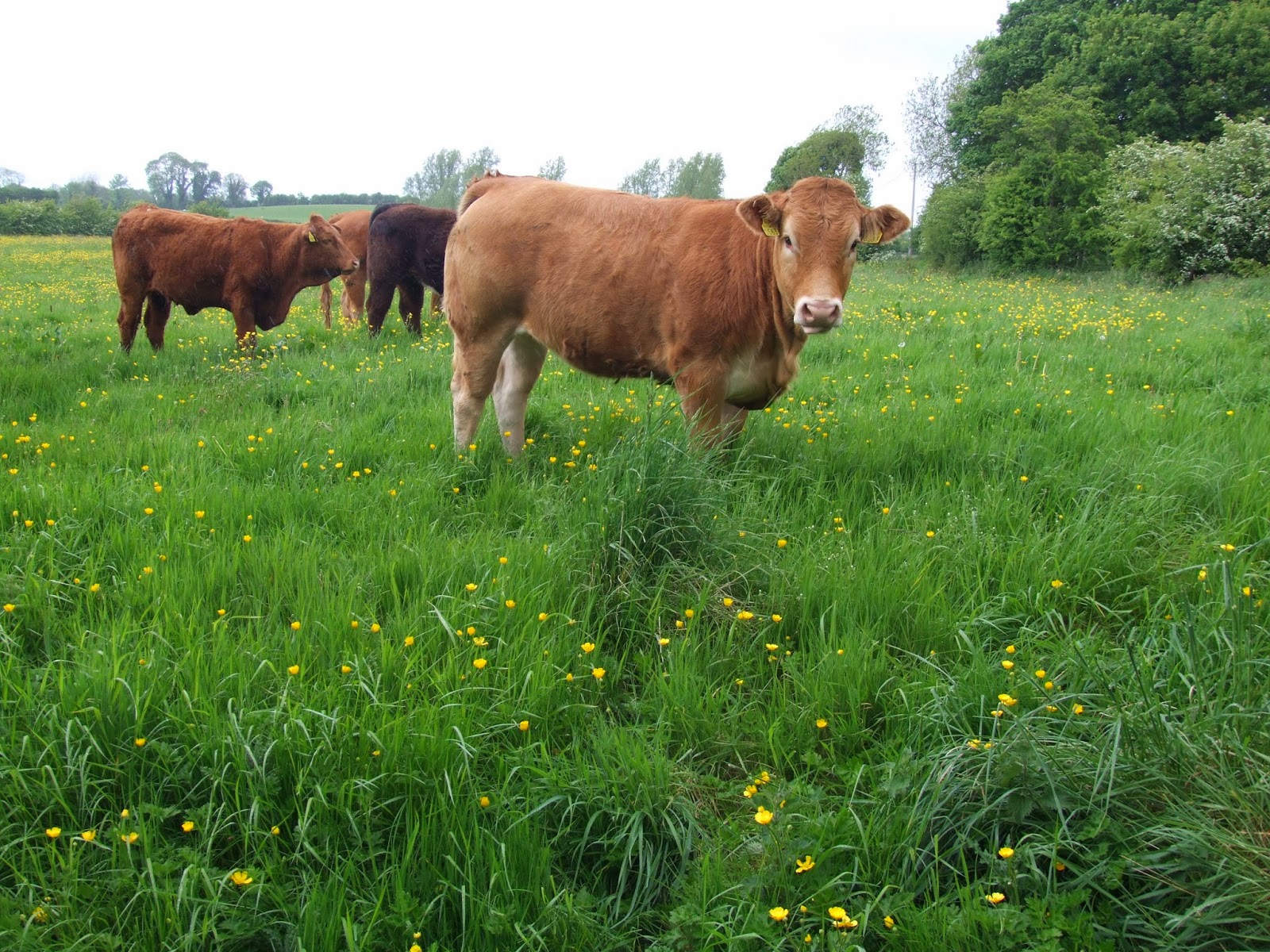
know), but some do bear the name of Saint Patrick. The Well of the White Cow is
situated at the base of Tara Hill and just to confuse matters it has multiple
names: Caprach Cormac; meaning ‘Cormac’s well’, a nod to one of the King’s at
Tara, Liagh; meaning ‘the Physician’s well’, possibly a reference to the belief
in its healing property, Tipra bo finne; meaning ‘the well of the White Cow’, Deare
dubhe; meaning ‘the well of the dark eye’ - possibly a description of it’s
appearance or relating to its power to heal the eyesight, and Poll tocair na
tuiliche; meaning ‘Trial by Ordeal’. There is a medieval manuscript that talks
about entering the waters and coming up again: if you had a black spot you were
guilty and if you were spotless you were innocent.
It is also known as Saint Patrick’s well. Some of these
names can be explained with their connection to myth (Poll tochair na
tuiliche), a possible local and more ‘modern’ fond invention (Caprach Cormac)
or simply names expressing its use or purpose (Liagh and Deare Dubh), but the name
of Tipra bo finne is by far the most intriguing name (although it to may be a
more modern association). This name appears in a mid medieval set of legends –
from which almost all of the legends of Tara come. You will read and you will
also be told that these legends are very early and speak of Ireland’s pagan
past, but it isn’t necessarily so. The myths are medieval in date in terms of
when they were collated by Christian monks, and they have been overlaid with
obscure imagery often to convey Christian ideas – and the white cow is one such
idea. The main citations for the myths of a pagan, life-giving cow are the
Ulster Cycle which contains the famous Tain Bo Cuailnge (Two sources; both
twelfth century), the Historical Cycle containing the famous vision of Conn of
the Hundred Battles (again a twelfth century work of poetry and prose) and the
Fenian or Ossianic Cycle which contains the famous story of the well surrounded
by trees and the salmon of wisdom (a thirteenth century work) and the
Mythological cycle (a twelfth century work). Most of these cycles are collated
works and include some earlier materials of short poems. The famous central
epic of the Táin is the most interesting. In it’s written form it has been
‘fiddled’ with by its Christian collators, but it still holds evidence of some
religious beliefs and ritual practices. It is essentially a glorification of
the warrior class, as bloodthirsty and gruesome as the description of the Celts
we find in Roman sources by Caesar, Livy, Strabo, Posidonius and Diodorus
Siculus. However it is possible to read this epic in the same way a Beowulf –
the final death of paganism. The central hero of the Táin dies at the end with
the unnerving presence of the Morrígan in the form of ravens, picking over his
corpse, and the entrails of one bull hanging from the enraged and victorious
bull.

The path to the well from the road
It is quite possible that legends of a white sacred, pagan
cow were retained orally in the Irish storytelling tradition, but the poetic
and prose works that were written in the twelfth and thirteenth centuries do contain
obscure Christian references – the symbolism of which is somewhat lost in the
passage of time (for example, some suggest that the tales of sacred cows
relates to the visions in the Book of Enoch)- and often use the tales as a
means to teach ethics and etiquette, or even to reinforce feudalism and
hierarchical social structures. But overall, the Táin does point to Ireland’s
pagan past and today is generally considered to be fairly good evidence of some
gods and goddesses that were held in a common belief, or at least known
commonly, around the first century AD.
Another layer of meaning to the legend of the white sacred
cow might come from Ireland’s early Christian past. The bulls of the Táin are
essentially symbol of virility and power and possibly in the version as we
have it, symbols of religious powers, but the early Christians in Ireland
placed great importance on cattle in relation to the production of food. One
of the very early practices of the early Christian monks in Ireland was to have
enough cattle to produce more milk than was needed for the religious community.
In producing a massive surplus of milk, they were able to endear themselves to
the pagan locals. Maybe they knew that the way to an Irishman’s heart and trust
was through the stomach. This practice of giving away free milk to the local
people gave rise to many myths and tales of enormous cattle kept in secret
barns in monasteries and about miraculous cattle that kept on producing vast
quantities of milk every single day of their lives. It also had a very positive
effect in some areas where the local people were so moved by the generosity of
the monks, that even when the monks left they continued the tradition of
providing free milk to the local community (Lemanaghan townland is an example
of this, having given away free milk right up until the 1950’s). It may well be
that this well has a more ancient dedication to another early Irish saint with
a connection to a ‘miraculous cow’! But we shall never really know, as this
well - like all the wells at Tara – has curiously been neglected and almost
forgotten until very recently. It is important to note that the other wells at
Tara have no dedication at all – they are either lost in the mists of time, or
they had no dedication to begin with.

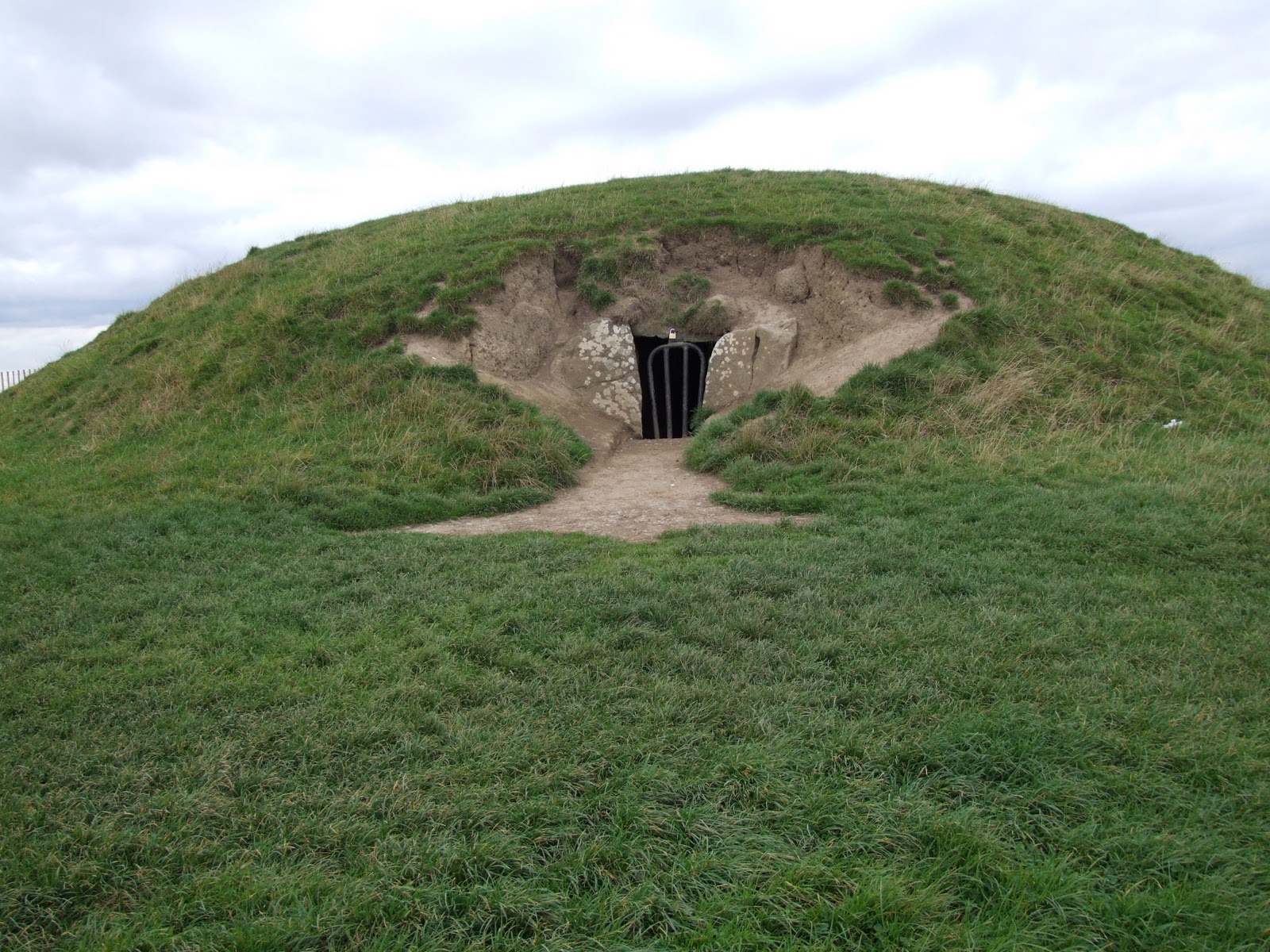
The Mound of the Hostages (a Neolithic passage tomb)
Tara is a peculiar place. It attracts curious tourists by
the busload, modern ‘druids’ and people who like Tolkien a little too
obsessively; it attracts the painfully mad and the frighteningly eccentric.
Consider yourself now well warned and always keep in mind that about the
ancient history of this site we know virtually nothing. The site is located on
the top of a large hill with the most magnificent views out over the valleys.
It is an ancient site with a Neolithic passage tomb (now closed to public
access and called ‘The Mound of the Hostages’), remains of an old ring fort and
a ceremonial avenue (labeled as the ‘Banqueting Hall’). It appears that the
site may have been used as a place to consecrate or make new Kings or chieftains
but it is unlikely that it was ever the official ‘seat’ of the High King of
Ireland. The crowning or consecration of Kings and the ‘official’ recognition
of chieftains has a long history of association to hills – the crowning of
O’Neil on Cave Hill being but one example. Hills like this have always held
importance: at Cave Hill Wolftone is said to have delivered rousing speeches
and in 1798 the rebel troops gathered to muster forces on Tara Hill.

Lia Fail (The Stone of Destiny)
Untangling the reality of what Tara is and the many myths
and stories about Tara is becoming increasingly difficult. A number of UK ‘new
agers’ have swamped the area, having stayed after a long protest against the
creation of a nearby motorway. The new age travellers have also been joined at
Tara by modern ‘druids’ and they both see the site as significant for their
religious beliefs and practices. They lay claim to Tara, suggesting that they
form an unbroken line of religious faith and ritual on the site that dates back
long before the arrival of Christianity, but the reality is that they bear very
little in common with the ancient Celts of Ireland, which is a good thing –
they don’t head hunt, they don’t practice human sacrifice and they don’t have
the same blood lust! Add to this the fact that Tara has been the victim of the
most unbelievable archaeological crimes. Various groups and people have come up
to this hill, dug large sections over and decided they have found nothing, but
in the process have destroyed much.
A fine example of this is the Lia Fail (Stone of Destiny), said to be a
stone that shrieked when stood on to indicate who it chose as a High King of
Ireland. At some point it was set into the ground like a standing stone and
surrounded by decorative small slabs. It is in fact the portal stone for the
passage tomb and would have at one time lain in a horizontal position at the
tomb entrance much like the highly decorated one at Newgrange.

The visitor's centre
Tara was likely a place to inaugurate, consecrate or make
new kings. Documents from the seventh century reference the area as an area of
importance for new kings who would drink ale as part of a ceremony in honour of
Maebh. Some have argued that it
was a place of political influence, at Ireland’s centre and a sacred place held
in high esteem by the entire population. There is absolutely no evidence for
this. It does seem possible that the site was significant to the local
population and by the first century AD was seen as significant for portions of
clans and tribes throughout Ireland, but it is highly unlikely that it was ever
understood as a site of significance for the whole island. Any chance of
finding out anything more about Tara has pretty much gone; in fact it probably
went when the British Israelites - who felt that the Irish were a lost tribe of
Israel – dug up Tara looking for the Ark of the Covenant. Tara unfortunately
still attracts many people of equal lunacy today. It is a curious site, but
whatever was ‘ancient’ about it has been destroyed by archaeological vandalism
in the past. It is an incredibly beautiful place with the most remarkable views
on a clear day. As a tourist you will be told all manner of wonderful takes and
be given great visions of a glorious past – all great fun and entertaining, but
take it all with a large dose of salt.

The well
The well of Tara is just off the road near the car park down past the collection of shops and café’s. Until very recently this well was a mere puddle in the middle of a farmer’s field. Cattle stood in it and drank the waters from around their feet. Today it has been transformed through the generous gifting of land by Dinny Donnelly and through the careful and thoughtful restoration by the National Well Restoration Society. It is now safely enclosed in a lightly undulating area, reminiscent of Tara hill itself and especially the Mound of the Hostages. Small hedges grow around the perimeter and there are seats and a few trees dedicated to peoples’ memory. The well has a small gate and is set into a small mound. The water is clear and the whole area is free of rubbish. It is quiet and peaceful and I must say it’s rather well done.
The interior of the well
Tara is significant for another reason. From Tara you can
see the hill of Slane very clearly and it was on that hill that Saint Patrick
is said to have lit his paschal fire as an act of clear defiance against the
pagan king who was on Tara hill to make a pagan festival at the same time. The
pagan king apparently saw Patrick’s fire blazing on top of Slane and was said
to be enraged. Patrick did not wait for a response, but instead he immediately
began to build his new Christian empire and he made Saint Erc the first Bishop
(Erc is buried on Slane hill). Together, they immediately set to work
converting the subjects of this pagan warlord on Tara. Legend has it that
Patrick was called into the presence of the pagan warlord, and in a myth that
echoes the account of Elijah and the prophets of Baal, Patrick had to
demonstrate the power of his God. Duly impressed, the pagan warlord permitted
the conversion of his subjects, but he himself remained a pagan to his dying day.
Contemporary historians place this event not at Tara at all, but on the mound
of Dowth.

Saint Erc's grave
The Well of the White Cow has never really had any religious activity around it – it was all but forgotten in the seventeenth and eighteenth centuries. The fact that it remained a puddle in a field until 2003 indicates just how much it had dropped out of local consciousness as a holy well site. It seems only fitting to say prayers here for all who travel, thinking of the many visitors who come to this place. Maybe here too, you can say a prayer for those who work on the land as farmers, but especially for the dairy farmers.
A view from Slane to Tara
O God, who called Abraham to leave his home, and protected him throughout his wanderings; grant to those who travel a successful journey and a safe arrival at their journey’s end. Be to them, Lord, a strength in weariness, a protection in danger, and a refuge in the storm, and grant that when life’s pilgrimage is over they may arrive at the heavenly country; through Jesus Christ our Lord. Amen.
Grant, O Lord, to all who have care of livestock, wisdom to understand your laws and to co-operate with your wise ordering of the world: and grant that the bountiful fruits of their labour may not be hoarded by the selfish nor squandered by the foolish, but that all may share in the bounty of creation; through Jesus Christ our Lord. Amen.
A statue of a stern Saint Patrick on Tara
How to find it:
From Dublin, head out the M3 until you see signs directing you to the Hill of Tara. It is well signposted. On arriving at the car park, travel down the road past the shops and small houses on your right and the well is set off the road on the right hand side, in a gated enclosure.
The Hill of Slane